Surrogacy in Mexico: Costs, Laws, and How to Choose the Right Agency - Expert Guide from Cryo Medical Logistics

Contact Cryo Medical Logistics

WhatsApp: +44 7585610211
Phone: +44 2081500059
Website: www.cryomedicallogistics.com
Mexico has firmly established itself as one of the world's most sought-after destinations for international surrogacy — and for good reason. With a progressive legal framework backed by a landmark Supreme Court ruling, world-class fertility clinics, inclusive family laws, and costs significantly lower than North America or Western Europe, Mexico offers intended parents a safe, legitimate, and accessible pathway to parenthood.
Thousands of families from the United States, Canada, the United Kingdom, Australia, and beyond have successfully built their families through surrogacy in Mexico. Yet navigating Mexico's surrogacy landscape requires genuine expertise. Laws vary by state, medical protocols demand careful vetting, and legal documentation must be handled flawlessly to protect your parental rights from day one.
This guide covers everything you need to know: the legal landscape, the step-by-step process, costs, safety requirements, and the critical role of specialist cryomedical logistics in getting your genetic material safely into Mexico. We have also compiled the most common questions people are asking right now on Google, ChatGPT, Perplexity, and other AI platforms — so you can make your decision with complete confidence.
Ready to start your journey? Email: transports@cryomedicallogistics.com
WhatsApp: +44 7585610211
Phone: +44 2081500059
Is Surrogacy Legal in Mexico?
Yes. In June 2021, Mexico's Supreme Court of Justice made a landmark ruling: surrogacy is a valid, constitutionally protected medical procedure available to all individuals, regardless of marital status, sexual orientation, gender identity, or nationality. This decision overturned previous state-level restrictions and established surrogacy as a recognised right under Mexican law.
State-by-State Legal Framework
Quintana Roo (including Cancún): One of Mexico's most surrogacy-friendly jurisdictions. Surrogacy has never been banned here. Both domestic and international intended parents are actively supported, and the region is home to several leading fertility clinics.
Jalisco: Issues birth certificates directly naming intended parents based on surrogacy contracts, often immediately after delivery. This streamlines the legal process considerably.
Mexico City: Following the 2026 Supreme Court clarification, uses the Voluntary Jurisdiction pathway to provide legal recognition of intended parenthood. A well-established surrogacy hub with excellent medical infrastructure.
Tabasco: Historically one of Mexico's original surrogacy states. Permits altruistic surrogacy for heterosexual couples. Commercial surrogacy for LGBTQ+ couples, single parents, and international intended parents is more restricted here.
States That Prohibit Surrogacy: Several states — including Coahuila, San Luis Potosí, and Querétaro — explicitly prohibit surrogacy. A reputable agency will always ensure you operate within a permissive legal jurisdiction.
Birth Certificates and Legal Parenthood
One of Mexico's most significant advantages is that babies born through surrogacy in the right jurisdictions receive birth certificates naming the intended parents as legal parents — not the surrogate. This automatic recognition of parenthood eliminates the need for post-birth adoption in many cases, though your family law attorney should verify requirements for your specific country of residence.
Babies born in Mexico automatically acquire Mexican citizenship. If at least one intended parent holds citizenship in another country, the child will typically qualify for dual citizenship, simplifying international travel and documentation.
Important Legal Cautions
While surrogacy is legal in Mexico, the U.S. Embassy and other consulates have cautioned that Mexican surrogacy law remains incomplete and subject to interpretation. This is why working with experienced, reputable agencies and specialist attorneys is non-negotiable.
Never work with agencies or clinics that:
Guarantee absolute legal certainty — no ethical provider can make this claim in any jurisdiction
Offer VIP packages promising expedited embassy appointments or tailored delivery dates
Suggest omitting the gestational mother from birth documentation
Pressure you to skip psychological evaluations or informed consent processes
Operate outside established Mexican legal frameworks
Working with the right legal team from day one protects your parental rights and ensures your baby's documentation is watertight for return to your home country.
Who Can Pursue Surrogacy in Mexico?
Mexico's 2021 Supreme Court ruling established that surrogacy is available to a wide range of intended parents. Mexico is one of the most inclusive surrogacy destinations in the world.
Eligible intended parents include:
Married heterosexual couples
Unmarried heterosexual couples
Same-sex male couples
Same-sex female couples
Single intended mothers
Single intended fathers
International intended parents from any country
LGBTQIA+ individuals and couples
Age requirements vary by clinic and state, but most require intended parents to be at least 21 years old. There is no strict upper age limit, though some clinics may apply their own guidelines based on medical factors.
Medical Requirements for Intended Parents
You will typically need to provide:
A complete medical history and current health assessment
Proof of infertility or medical contraindication to pregnancy — not required for LGBTQ+ couples or single parents
Infectious disease screening (HIV, hepatitis, sexually transmitted infections)
Psychological evaluation confirming readiness and emotional stability
Proof of financial stability to cover all surrogacy costs
Valid passports, birth certificates, and marriage certificate if applicable
All documents translated into Spanish and notarised within Mexico
A Critical Note on Genetic Parenthood
At least one intended parent should ideally have a genetic connection to the child — contributing either eggs or sperm. This significantly simplifies citizenship recognition and parentage documentation in your home country.
If you are using both donated eggs and donated sperm — meaning neither intended parent has a genetic relationship to the child — consult your home country's embassy or consulate early in the process. Some nations require genetic relatedness for citizenship recognition, which could complicate your baby's passport application.
Surrogate Qualifications and Screening in Mexico
Mexico has strict requirements for surrogate mothers to protect the health, safety, and wellbeing of everyone involved. Reputable agencies conduct four-stage screening covering medical, psychological, legal, and social evaluations.
Surrogate eligibility requirements:
Aged between 25 and 35 years old for optimal health outcomes
Must have had at least one successful, healthy full-term pregnancy
Excellent general and reproductive health, verified through comprehensive medical examination
Psychologically stable, confirmed through independent evaluation
No history of substance abuse, including smoking and excessive alcohol
Must be a Mexican citizen or permanent resident
Must live near the fertility clinic for regular monitoring
Must be legally single in most jurisdictions
Must provide full informed consent and demonstrate complete understanding of the surrogacy process
Must have independent legal representation before signing any agreements
Surrogate Compensation
Because Mexico does not have a formal national surrogacy law, most arrangements are structured to comply with constitutional protections. Surrogates are typically compensated for medical expenses, living costs during pregnancy, lost income, and maternity clothing. Additional compensation after successful delivery is common depending on the agency's programme and contract terms.
Surrogate compensation in Mexico is generally lower than in the United States, which is one reason the overall cost of surrogacy in Mexico is significantly more affordable — without any reduction in the quality of care provided to your surrogate.
The Surrogacy Process in Mexico: Step by Step
A complete surrogacy journey in Mexico typically takes between 9 and 12 months from initial consultation to bringing your baby home. Here is what to expect at each stage.
Step 1: Initial Consultation and Qualification (Month 1)
Your journey begins with a comprehensive consultation with your chosen surrogacy agency. You will discuss your medical history, family-building goals, timeline, budget, and any specific preferences. Your agency will outline the legal process for your chosen state and confirm your eligibility.
Step 2: Medical and Psychological Screening (Month 1–2)
Both you and your surrogate undergo full medical evaluations. Psychological screening confirms emotional readiness for all parties. This is a protective measure that benefits everyone involved — not a barrier to proceeding.
If you are using donor eggs or donor sperm, donors undergo rigorous screening including:
Genetic testing and ovarian reserve assessment (for egg donors)
Screening for HIV, hepatitis, gonorrhea, syphilis, and chlamydia
Psychological evaluation confirming informed consent
Lifestyle and background assessment
Note: Only anonymous donation is permitted in Mexico, protecting donor privacy whilst maintaining full medical records.
Step 3: Legal Documentation and Surrogacy Agreement (Month 2–3)
Your surrogacy agreement is drafted by specialist reproductive law attorneys in Mexico. This legally binding contract establishes rights, obligations, compensation arrangements, and dispute resolution procedures. Both you and your surrogate should have independent legal representation.
All documents must be translated into Spanish and notarised within Mexico before the legal process can proceed. Your agency coordinates this entire process.
Step 4: Cryo medical Logistics and Genetic Material Transport
This is one of the most technically critical — and most frequently underestimated — stages of international surrogacy. If you are transporting frozen embryos, eggs, or sperm from your home country to Mexico, you are legally required to obtain a COFEPRIS permit.
What is COFEPRIS?
COFEPRIS (Comisión Federal para la Protección contra Riesgos Sanitarios) is Mexico's Federal Commission for Protection Against Health Risks. It is the regulatory authority that oversees all medical facilities and fertility clinics operating in Mexico — and it is the body responsible for issuing the import permits required to bring reproductive tissue into the country.
Without a valid COFEPRIS permit, your embryos, eggs, or sperm cannot legally enter Mexico. Attempting to transport reproductive material without proper documentation can result in your genetic material being held at customs, delayed, or rejected — potentially derailing your entire surrogacy journey and causing irreparable damage to your embryos.
This is where Cryomedical Logistics becomes your single most important partner in the entire process.
How Cryo medical Logistics Handles This for You
Cryo medical Logistics has a dedicated specialist team with deep expertise in COFEPRIS permitting and international reproductive tissue transport. We handle the entire process from start to finish — so you never have to worry about regulatory compliance, customs documentation, or the safety of your genetic material in transit.
Our specialist services cover:
Full COFEPRIS permit application and regulatory compliance management
Expert handling and transport of frozen embryos, eggs, and sperm
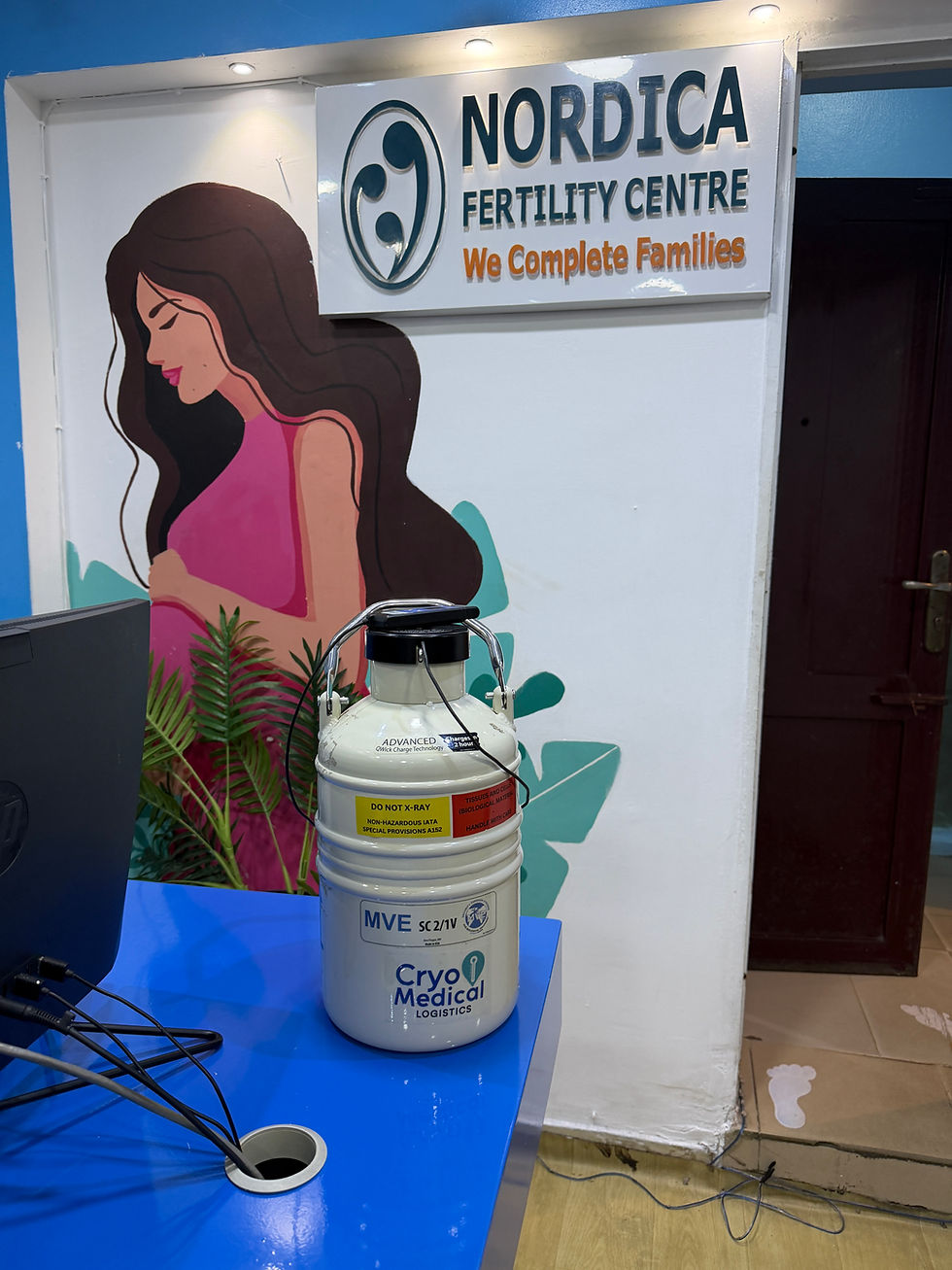
Temperature-controlled cryogenic containers maintained throughout transit
Real-time monitoring and documentation at every stage of the journey
Hand-carry transport by trained medical couriers who personally accompany your reproductive material
Full insurance coverage and chain-of-custody documentation
Coordination with your origin laboratory and destination fertility clinic in Mexico
Complete paperwork, translations, and notarisation support
We transport reproductive material from any country into Mexico's leading fertility hubs, including Cancún, Mexico City, Mérida, Guadalajara, and Puerto Vallarta.
With Cryo medical Logistics managing your cryomedical transport, your genetic material arrives safely, legally, and on time — every time.
Do not leave the transport of your embryos, eggs, or sperm to chance. Contact Cryo medical Logistics today via WhatsApp or email to discuss your specific requirements.
Step 5: IVF and Embryo Transfer (Month 3–4)
If you do not already have viable embryos, the IVF process begins once your genetic material has arrived safely at the clinic. This involves:
Hormone stimulation of the egg provider to produce multiple mature eggs
Egg retrieval through a minor surgical procedure
Sperm collection and processing
Fertilisation of eggs in the laboratory
Embryo development monitoring over 5 to 6 days
Optional preimplantation genetic testing (PGT-A) to screen for chromosomal abnormalities — this improves success rates and reduces miscarriage risk
Gender selection is possible through PGT-A testing, subject to local regulations
Once embryos are ready, the surrogate undergoes uterine preparation and the embryo transfer procedure. Pregnancy is confirmed 10 to 14 days after transfer. Success rates in Mexico's leading clinics range from 50 to 70 percent per transfer, depending on embryo quality and surrogate health.
Step 6: Pregnancy and Prenatal Care (Month 4–9)
Your surrogate carries the pregnancy while receiving regular prenatal care from the clinic's medical team. You will receive regular updates, ultrasound images, and communication from your surrogate throughout. Reputable agencies facilitate regular contact between intended parents and surrogate, building the emotional connection many families value.
Most intended parents travel to Mexico for the embryo transfer and make plans to return for the delivery. Some choose to spend extended time in Mexico during the pregnancy — this is entirely optional.
Step 7: Delivery and Legal Finalisation (Month 9–10)
You will travel to Mexico for the birth. Major surrogacy hubs including Cancún, Mexico City, and Mérida have modern obstetric facilities with neonatal intensive care units (NICUs) for any complications.
After delivery, the baby receives a Mexican birth certificate naming you as the legal parents. Legal documentation is completed to formally recognise your parental rights under Mexican law, typically through the Voluntary Jurisdiction pathway or the Judicial Amparo Process, depending on your state.
Step 8: Return Home and International Documentation (Month 10–12)
Once the birth certificate is issued, you will work with your agency and legal team to secure your baby's Mexican passport and any additional travel documentation. Depending on your citizenship and the baby's genetic parentage, you may need to:
File an eCRBA (Consular Report of Birth Abroad) — for U.S. citizens
Provide DNA evidence of genetic parentage for citizenship recognition
Complete additional parentage recognition or adoption proceedings in your home country
Apply for your baby's home country passport
Most intended parents should plan for a stay of one to three months in Mexico after the birth to complete legal formalities and obtain travel documents. Your agency coordinates all of this process.
Cost of Surrogacy in Mexico: Full 2026 Breakdown
Surrogacy in Mexico costs between 40 and 60 percent less than comparable programmes in the United States or Canada — without compromising on medical quality or legal protection.
Complete programme costs (2026):
Standard programme (intended parents with existing embryos): From $58,000 USD
Full programme including IVF: $70,000 to $100,000 USD
Fixed-cost guarantee programme: $85,000 to $100,000 USD (unlimited IVF cycles until successful birth)
Itemised Cost Breakdown
Medical costs: $15,000 to $25,000 USD
Fertility testing and consultations
IVF cycle and embryo creation
Preimplantation genetic testing (PGT-A) — optional
Embryo transfer procedure
Prenatal care and monitoring throughout pregnancy
Delivery and postpartum care
Newborn care and testing
Surrogate compensation and care: $15,000 to $20,000 USD
Surrogate base compensation
Health insurance and medical expenses throughout pregnancy
Maternity clothing and pregnancy support
Post-delivery care and recovery support
Legal and administrative fees: $10,000 to $15,000 USD
Surrogacy contract drafting and notarisation
Birth certificate processing and parental rights documentation
Voluntary Jurisdiction or Judicial Amparo Process
Translation and notarisation of all documents
Independent legal representation for both parties
Agency fees: $8,000 to $12,000 USD
Surrogate matching and screening
Case management and coordination
Communication and support throughout the process
24/7 support for intended parents and surrogate
Cryomedical Logistics: $10,000 to 15,000USD
COFEPRIS permit application and regulatory compliance
International transport of embryos, eggs, or sperm
Temperature-controlled cryogenic handling and storage
Insurance, chain-of-custody documentation, and courier services
Coordination with origin and destination laboratories
Travel and accommodation: $5,000 to $10,000 USD
Flights for intended parents (multiple trips)
Accommodation during embryo transfer visit (3 to 5 days)
Accommodation during delivery and post-birth stay (4 to 12 weeks)
Meals and local transportation
Potential additional costs:
Egg donation: $5,000 to $8,000 USD additional
Sperm donation: $1,000 to $2,000 USD additional
Twin pregnancy additional compensation: varies by agency
Extended NICU care: ensure your package includes contingency coverage
Home country legal fees for final parentage recognition
Embassy and consulate fees for passport and citizenship applications
Be cautious of programmes priced significantly below $65,000 USD. Unrealistically low costs often signal corners being cut on surrogate care, legal protection, or medical oversight. Contact Cryomedical Logistics to discuss what a realistic, transparent budget looks like for your situation.
Safety, Authority, and Choosing the Right Team
Surrogacy is one of the most significant journeys of your life. Your safety — medical, legal, and emotional — depends entirely on the expertise and integrity of the team supporting you.
Choosing a Reputable Surrogacy Agency
A proven track record with verifiable client testimonials and references
Transparency about legal risks as well as benefits — no ethical agency claims surrogacy in Mexico is entirely risk-free
Partnership with COFEPRIS-accredited fertility clinics
Rigorous four-stage surrogate screening: medical, psychological, legal, and social
Independent legal representation for both intended parents and surrogate
Clear, itemised cost structures with no hidden fees
24/7 support throughout the process
Experience with international clients from your specific home country
Choosing a Reputable Fertility Clinic
Ask every clinic you consider:
Are you registered and inspected by COFEPRIS?
What is your embryo transfer success rate per cycle?
Do you have NICU facilities or hospital partnerships for high-risk births?
How often are surrogates monitored during pregnancy?
What is your emergency protocol if complications arise?
Are your embryologists internationally certified?
What are your laboratory standards for embryo creation and storage?
Red Flags to Walk Away From
Guarantees a 100 percent success rate — no legitimate provider can promise this
Pressures you to move quickly without completing proper screening
Is unwilling to discuss risks or complications honestly
Cannot provide clear COFEPRIS registration credentials
Offers to omit the gestational mother from birth documentation
Provides vague or incomplete cost disclosures
Cannot provide references from previous international clients
Suggests bypassing psychological evaluations
The Role of Cryo medical Logistics in Your Safety
One area where many intended parents are dangerously under informed is the transport of their reproductive material into Mexico. This is not simply a shipping question — it is a medical, regulatory, and legal matter that requires specialist expertise.
To legally import embryos, eggs, or sperm into Mexico, a COFEPRIS permit must be obtained before transport begins. Attempting to transport reproductive material without a valid COFEPRIS permit risks:
Your genetic material being detained or rejected at customs
Exposure of embryos or eggs to uncontrolled temperatures during delays
Significant legal complications affecting your entire surrogacy timeline
Potential irreversible damage to your embryos, eggs, or sperm
Cryo medical Logistics has an in-house specialist team dedicated entirely to COFEPRIS permit management and international reproductive tissue transport. When you work with Cryo medical Logistics, you benefit from:
A dedicated permit specialist who manages your COFEPRIS application from start to finish
Expert cryogenic couriers who hand-carry your genetic material with continuous temperature monitoring
Full chain-of-custody documentation at every stage
Complete insurance coverage for your reproductive material in transit
Direct coordination with your origin clinic and your Mexico fertility clinic
Over a decade of specialist experience in cryo medical transport
Your embryos, eggs, and sperm represent the foundation of your family. Do not entrust their transport to anyone without specialist COFEPRIS expertise. Contact Cryomedical Logistics today — we handle everything.
Frequently Asked Questions
Legal Questions
Is surrogacy actually legal in Mexico? Yes. The Mexican Supreme Court ruled in June 2021 that surrogacy is a constitutionally protected right for all individuals. However, legality is governed at state level, not federally. Quintana Roo, Jalisco, Mexico City, and several other states actively support surrogacy for all family types. Some states restrict or prohibit it entirely. Always work with an agency that operates in a legally permissive state.
Do I need to be married to pursue surrogacy in Mexico? No. Single intended parents, unmarried couples, LGBTQ+ couples, and married couples are all eligible. The 2021 Supreme Court ruling explicitly protects all family structures.
Can same-sex couples pursue surrogacy in Mexico? Absolutely. Both same-sex male couples (using egg donation) and same-sex female couples (using sperm donation) are fully eligible in permissive states. Ideally, at least one partner should be a genetic parent to simplify citizenship and parentage recognition in your home country.
Will my baby be recognised as my child by my home country? Babies born in Mexico receive a birth certificate naming intended parents as legal parents under Mexican law. However, your home country's recognition of surrogacy-born children varies. U.S. citizens need to file an eCRBA. UK, Canadian, Australian, and European parents should consult their embassy early in the process. A specialist legal team will guide you through this.
Can the surrogate change her mind and keep the baby? In theory, Mexican law recognises the gestational mother as having full parental rights at birth. In practice, this risk is virtually eliminated when you work with a properly screened, psychologically evaluated surrogate operating under a clear legal framework. In well-managed programmes using the Judicial Amparo or Voluntary Jurisdiction pathways, surrogate parental rights are formally terminated as part of the legal process.
How long does surrogacy in Mexico take? Most complete surrogacy journeys take between 9 and 12 months from initial consultation to bringing your baby home. The process can be shorter if you already have frozen embryos ready for transfer.
Do I need to stay in Mexico the entire time? No. Most intended parents travel to Mexico for key stages: the embryo transfer (3 to 5 days), the delivery and immediate post-birth period (5 to 7 days minimum), and to complete legal documentation (which may require a stay of several weeks to months). Many parents manage the rest of the process remotely with regular updates from their agency.
How do I get my embryos, eggs, or sperm into Mexico? This is one of the most important practical questions in international surrogacy. A COFEPRIS permit is legally required to import reproductive tissue into Mexico. Without this permit, your genetic material cannot be legally transported into the country. Cryo medical Logistics specialises entirely in this process — we obtain the COFEPRIS permit on your behalf, manage all regulatory documentation, and transport your reproductive material safely using specialist cryogenic couriers. Contact us directly to discuss your specific situation.
What if the first embryo transfer doesn't work? Most reputable agencies include surrogate replacement and additional transfer cycles in their programmes. Fixed-cost or guarantee programmes offer unlimited transfers until a successful birth, for a set overall fee.
How much does surrogacy in Mexico cost in 2026? A complete surrogacy programme in Mexico ranges from approximately $58,000 USD for intended parents with existing embryos to $100,000 USD for full programmes including IVF. Fixed-cost guarantee programmes typically range from $85,000 to $100,000 USD and include unlimited IVF cycles until a successful birth.
Is surrogacy in Mexico cheaper than in the US? Yes — significantly. Surrogacy in the United States typically costs between $120,000 and $180,000 USD or more. Mexico offers the same level of medical expertise and legal protection at 40 to 60 percent less cost.
What are the hidden costs I should watch out for? Legitimate agencies provide fully itemised cost breakdowns. Potential additional costs include egg or sperm donation fees, twin pregnancy additional compensation, extended NICU care, COFEPRIS permit and cryo medical logistics fees, home-country legal fees for final parentage recognition, and embassy or consulate fees for citizenship and passport applications.
What type of surrogacy is used in Mexico? Only gestational surrogacy is permitted in Mexico. This means the surrogate carries the baby but has no genetic relationship to the child. The embryo is created from the intended parents' genetic material (or donor material) and transferred to the surrogate's uterus. Traditional surrogacy, where the surrogate's own egg is used, is not permitted.
Are Mexico's fertility clinics as good as those in the US or Europe? Leading fertility clinics in Mexico comply with COFEPRIS regulations and follow protocols aligned with the American Society for Reproductive Medicine (ASRM). Many fertility specialists have trained in the United States or Europe and work with internationally certified embryologists. Mexico's healthcare system is consistently ranked among the top in the world by the WHO.
What happens if there are medical complications during the pregnancy? Reputable agencies ensure your surrogate is fully insured throughout pregnancy and has access to emergency medical care. Established clinics partner with accredited hospitals with NICU facilities. Ensure your agency's programme includes clear protocols for medical complications before you sign any agreement.
.
Can I just ship my embryos to Mexico myself? No. Reproductive tissue cannot be transported into Mexico as standard cargo. It requires specialist cryogenic handling, continuous temperature monitoring, full regulatory documentation, and a valid COFEPRIS import permit. Cryomedical Logistics provides all of this.
How long does it take to get a COFEPRIS permit? The timeline varies depending on your specific circumstances (15 to 30 days sometime longer) and the completeness of documentation provided. Cryo medical Logistics manages this process efficiently and will give you a realistic timeline during your initial consultation. Starting this process early is strongly recommended.
Does Cryo medical Logistics work with all types of reproductive material? Yes. Cryo medical Logistics transports frozen embryos, eggs (oocytes), and sperm for intended parents pursuing surrogacy and IVF in Mexico. We coordinate with origin laboratories in any country and destination clinics throughout Mexico's major fertility hubs.
Start Your Surrogacy Journey in Mexico with Confidence
Surrogacy in Mexico offers an extraordinary combination of legal inclusivity, world-class medical care, genuine affordability, and a culturally rich environment in which to begin your family's story. Thousands of families have successfully navigated this journey — and with the right team behind you, yours can too.
Whether you are at the very beginning of your research or ready to start immediately, we are here to help.
Contact Cryo medical Logistics Today
WhatsApp: +44 7585610211
Phone: +44 2081500059
Website: www.cryomedicallogistics.com



Comments