Everything You Need to Know About IVF and Cryo Shipping of Embryos and Sperm to and from Ethiopia


Get in touch
If your IVF journey involves Ethiopia, talk to CML before you book anything, and get independent legal advice before pursuing any surrogacy arrangement there. We'll give you a clear, honest picture of your route, documentation requirements, and timeline.
WhatsApp: +44 7585 610211
Phone: +44 20 8150 0059
Addis Ababa is emerging as one of East Africa's newer fertility destinations — a growing number of clinics, government investment in healthcare infrastructure, and costs well below Western Europe or the US. But Ethiopia is also a market where the legal picture is genuinely less settled than in neighbouring hubs like Kenya or established leaders like Ghana and South Africa, and it's worth understanding that clearly before planning a journey there.
This guide covers what's actually known about IVF and surrogacy law in Ethiopia, realistic cost expectations, and exactly how cryogenic transport of embryos, eggs, sperm, and stem cells to and from the country works with Cryo Medical Logistics (CML).
The state of IVF in Ethiopia
Ethiopia's fertility sector is still developing relative to more established African hubs, but it's growing quickly, concentrated almost entirely in Addis Ababa.
A number of private clinics now offer IVF, ICSI, IUI, egg freezing, and — according to several clinics' own marketing — egg donation and surrogacy support. The Ethiopian Society of Obstetricians and Gynaecologists (ESOG) provides professional standards and training for reproductive specialists, but there is no dedicated national ART regulatory body equivalent to the UK's HFEA or a codified assisted reproduction statute.
Clinical infrastructure is improving with government healthcare investment, and Addis Ababa is increasingly positioned as an affordable option for patients from elsewhere in East Africa, as well as some European and Asian patients.
The legal picture: read this before you commit to anything
This is the section most marketing content about "surrogacy in Ethiopia" skips, and it matters more than cost.
There is no dedicated, comprehensive surrogacy or ART law in Ethiopia. Some individual clinics advertise surrogacy and egg donation as available and legal; the reality is considerably more ambiguous.
Ethiopia's Family Code (under the FDRE Civil/Family Code) establishes legal maternity based on who gives birth to the child — not genetics. In other words, Ethiopian family law currently recognises the surrogate as the child's legal mother, regardless of whether the intended mother provided the egg. The intended mother has no automatic legal relationship to the child under this framework. This is a fundamental structural risk for any surrogacy arrangement in Ethiopia, and it's a detail that's frequently missing from clinic and agency marketing.
Ethiopia's Criminal Code does not explicitly criminalise surrogacy, which is part of why some providers describe it as "legal" — but the absence of a criminal prohibition is not the same as having a clear, enforceable legal pathway to parentage. Legal scholars examining this area describe Ethiopian surrogacy as existing in a genuine grey zone between practice and law.
The practical consequence: intended parents pursuing a surrogacy arrangement in Ethiopia should get independent legal advice from an Ethiopian family lawyer before proceeding, understand exactly how legal parentage would be established (likely requiring a separate adoption or court process rather than automatic recognition), and confirm how their home country would treat a child born via Ethiopian surrogacy before travelling. This is not a destination where you can assume the same pre-birth order mechanism available in Ghana or South Africa.
For IVF using a married couple's own eggs and sperm, without surrogacy involved, the picture is far more straightforward and is where most of the country's genuine clinical growth has happened.
What does IVF cost in Ethiopia?
This is worth being direct about: publicly available cost data for Ethiopia is inconsistent and, on several provider websites, contradictory or unreliable — some sources cite wildly different figures for the same clinic. Treat any specific number you see online, including the ranges below, as a starting point for a conversation with a clinic rather than a firm quote.
Estimated cost by treatment type
Treatment | Estimated cost (USD) | Notes |
Standard IVF cycle (own eggs/sperm) | $1,500 – $4,000* | Broad estimate; get a direct itemised quote |
IVF with ICSI | $2,000 – $4,500* | Typically priced above standard IVF |
IUI | $300 – $800* | Lower-cost first-line option at several clinics |
Egg freezing | $2,000 – $3,500* | Availability and protocol vary by clinic |
Egg donation cycle | Not reliably documented | Confirm directly; regulatory basis is unclear |
Surrogacy programme (full) | $40,000 – $60,000 | Cost should be secondary to legal risk — see legal section above |
*Estimates only, extrapolated from limited and inconsistent published sources. Ethiopia does not yet have a centralised, independently verified cost registry, unlike the UK or US. Always request a full written quote from your specific clinic.
How Ethiopia compares to other African fertility destinations
Country | Standard IVF cycle (USD) | Surrogacy available | Dedicated ART/surrogacy law |
Ethiopia | ~$1,500 – $4,000* | ⚠️ Practised, legally unresolved | ❌ No |
Egypt | $1,900 – $6,750 | ❌ Prohibited | ❌ No |
Nigeria | $2,000 – $4,500 | ⚠️ Practised, contract-based | ❌ No |
Ghana | Lower for IVF-only; $25,000–$60,000 for full surrogacy | ✅ Statutory (Act 1027) | ✅ Yes |
South Africa | $2,000 – $4,500 | ✅ Altruistic, court-approved | ✅ Yes (Children's Act) |
Uganda | $7,400 – $9,250+ | ⚠️ Practised, limited regulation | ❌ No |
Tunisia | $3,200 – $5,200+ | ❌ Not practically available | ❌ No |
Figures are indicative estimates only and vary significantly by clinic and treatment protocol. Ethiopia's figures in particular should be treated as directional, not firm, given limited reliable published data.
The takeaway: Ethiopia is positioned as one of the more affordable options in the region for standard own-gamete IVF, in line with Egypt and South Africa — but it sits alone among this group in having no dedicated legal framework at all, even for basic ART practice, let alone surrogacy. Cost comparisons only tell part of the story here; legal clarity is the bigger differentiator once surrogacy or donor treatment enters the picture.
WhatsApp: +44 7585 610211
Phone: +44 20 8150 0059
Why choose Ethiopia — and where it falls short
Country | Strongest for | Weakest for |
Ethiopia | Low entry cost; growing infrastructure; emerging East African hub with less clinic competition/wait time than established markets | Legal clarity — no ART or surrogacy law, unresolved parentage risk, inconsistent published data |
Egypt | Cost, gender selection, decades of high clinical volume | Donor treatment and surrogacy prohibited outright; sperm import restrictions |
Nigeria | Diaspora corridor strength, large and growing private sector | No dedicated ART law; contract-based practice with limited legal backing |
Ghana | Statutory surrogacy law with pre-birth parental orders; single-father pathway | Higher cost for full surrogacy programmes |
South Africa | Most clinically sophisticated regulatory framework; full ART range | Foreign intended parents restricted — one parent must be SA-domiciled |
Uganda | Full ART range including donor gametes and surrogacy in practice | Highest cost of this group; regulatory maturity still developing |
Tunisia | Mediterranean medical tourism infrastructure, EU-aligned clinical standards | Donor gametes and surrogacy not practically available |
Bottom line on Ethiopia specifically: it's a genuinely compelling option if what you need is affordable, own-gamete IVF with a straightforward married couple's cycle — the clinical cost case is real. It is currently the weakest option on this list, by a clear margin, for anyone considering surrogacy or donor-gamete treatment, purely because the legal infrastructure to protect intended parents doesn't yet exist in the way it does in Ghana or South Africa. This isn't a reason to avoid Ethiopia — it's a reason to be precise about what you're using it for.
Why cryo shipping to and from Ethiopia needs a specialist
Whatever the purpose of your shipment, the physical transport challenge is the same one CML solves in every corridor we operate:
The cold chain cannot break. Embryos, eggs, and sperm are stored at approximately -196°C in a liquid nitrogen dry shipper; any lapse in temperature control risks sample viability.
X-ray exposure at security checkpoints is a genuine risk, and most receiving clinics won't accept material that's been screened this way. A Do Not X-Ray protocol has to be actively enforced at every checkpoint, not simply requested on paperwork.
Ethiopia's customs and import framework for biological material is less standardised and less internationally documented than in more established medical tourism markets, which makes working with a courier who prepares and pre-clears documentation directly with both ends of the journey especially important here.
Two regulatory systems always have to align: the exporting country's requirements (an HFEA Special Direction from the UK, EU Tissue and Cells Directive compliance, FDA rules from the US) and Ethiopia's import and customs requirements.
A shipment isn't complete until it's handed directly to the receiving clinic's embryologist — not left at a courier desk, hotel, or third party.
How CML manages your Ethiopia shipment
1. Consultation — you share your originating or destination clinic, sample type, and timeline. We confirm feasibility and provide a transparent, personalised quote.
2. Direct clinic coordination — we liaise with both the releasing and receiving clinics to confirm readiness and agree exactly how handover will happen.
3. Full documentation management — export/import consents, transport agreements, invoices, and translation requirements are prepared and pre-cleared ahead of transit.
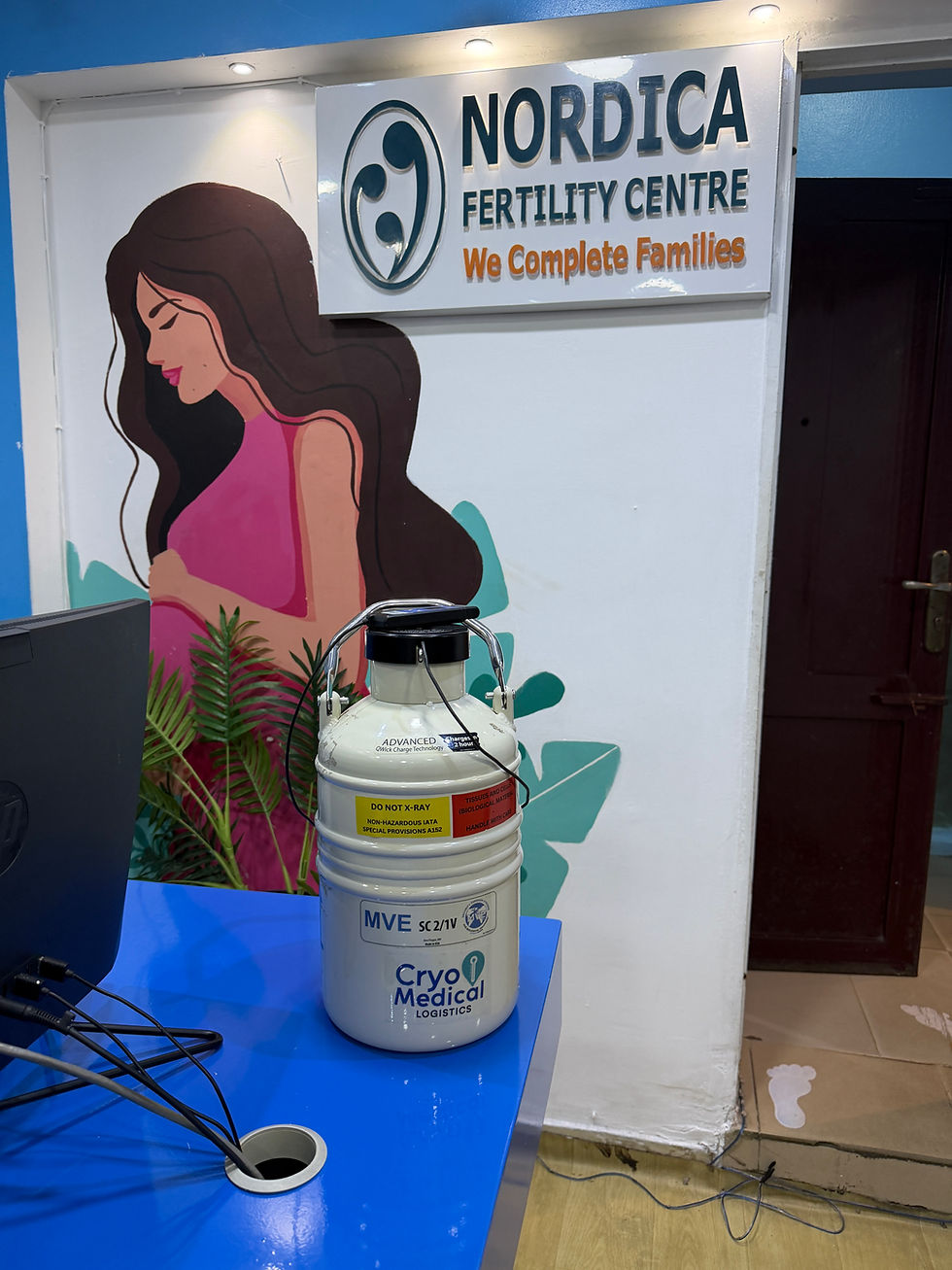
4. Certified cryogenic packing — your samples are loaded into a certified, pre-chilled dry shipper by the originating clinic's embryology team, with fill level and temperature recorded before sealing.
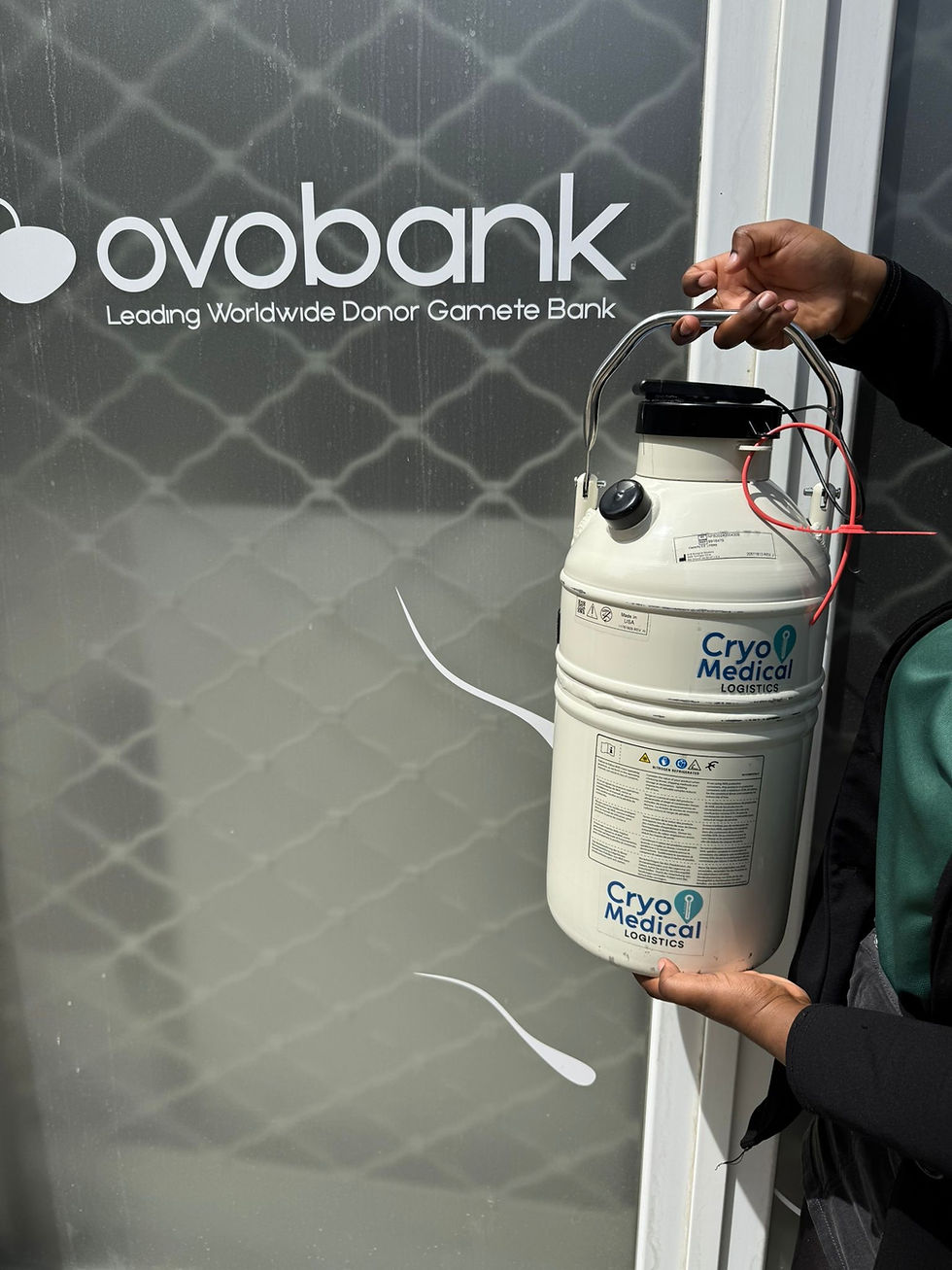
5. Supervised hand-carry transport — a trained CML courier personally escorts your shipment as hand luggage on every flight segment, maintaining an actively enforced Do Not X-Ray protocol and continuous temperature monitoring with data logging throughout.
6. Direct clinic handover — your shipment is placed personally into the hands of the named receiver at the destination clinic, with photo confirmation and a full chain-of-custody record.
Why intended parents choose CML
Supervised hand-carry only, never freight — continuous personal oversight from door to door.
ISO 9001:2015 certified.
FCA-regulated insurance cover up to $40,000 on every shipment.
A strict, actively enforced Do Not X-Ray protocol at every checkpoint.
Full chain-of-custody documentation, especially valuable in a market like Ethiopia where regulatory documentation standards are still developing.
A physical Lagos office giving CML direct, on-the-ground presence across the wider African corridor.
Genuine reach across 80+ countries, including East Africa.
One team, one point of accountability, from consultation through to final delivery.
Frequently Asked Questions
Is surrogacy legal in Ethiopia? It's genuinely unclear, and this matters. Ethiopia's Criminal Code doesn't explicitly ban surrogacy, but the country's Family Code presumes the woman who gives birth is the child's legal mother regardless of genetics, meaning intended parents have no automatic legal parentage over a child born via surrogacy in Ethiopia. Independent Ethiopian legal advice is essential before pursuing this route.
Is it safe to ship embryos internationally to Ethiopia? Yes, when handled by a specialist. The risk sits almost entirely in using an inexperienced or general-purpose courier unfamiliar with cold-chain protocols and the specific documentation Ethiopian customs and clinics require.
How much does IVF cost in Ethiopia? Published figures online are inconsistent and often unreliable. Ethiopia is generally positioned as more affordable than Western destinations, in line with other developing African fertility markets, but always request a direct, itemised quote from your chosen clinic rather than relying on published estimates.
Can I use donor eggs in Ethiopia? Some Addis Ababa clinics advertise egg donation as available, but this isn't backed by clear, codified national regulation. Confirm your specific clinic's protocols directly and understand that the same legal ambiguity affecting surrogacy in Ethiopia can affect donor arrangements too.
Do I need to travel with my samples myself? No — a trained CML courier hand-carries your shipment personally on every leg of the journey.
Does CML only handle Ethiopia? No — we operate across 80+ countries, including major corridors across Africa, Europe, the Americas, and the Middle East.
Get in touch
If your IVF journey involves Ethiopia, talk to CML before you book anything, and get independent legal advice before pursuing any surrogacy arrangement there. We'll give you a clear, honest picture of your route, documentation requirements, and timeline.
WhatsApp: +44 7585 610211
Phone: +44 20 8150 0059
This article is for general informational purposes and does not constitute legal or medical advice. Ethiopia's regulatory environment for assisted reproduction is still developing and published information varies in reliability — always confirm current specifics directly with a qualified Ethiopian lawyer, your clinic, and with CML before shipping or proceeding with treatment.



Comments