IVF and Donor Eggs in Spain: Why Families Choose Spain and How to Move Your Embryos and Eggs

Spain is one of Europe's leading destinations for fertility treatment, especially egg donation, thanks to a clear legal framework and well-established donor programmes.
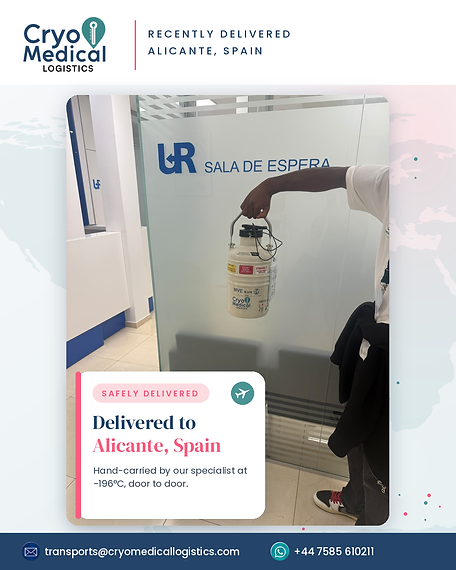
We recently delivered reproductive samples to a fertility clinic in Alicante.
This guide explains why so many families look to Spain, what to check before you start, and how moving your eggs, sperm or embryos can make treatment there easier.
Why Spain for donor eggs
Egg donation in Spain is legal, tightly regulated and well established under Law 14/2006 on Assisted Human Reproduction Techniques (source).
Rule | What it means for you |
Donor age | Egg donors must be 18 to 35 |
Health screening | Donors pass medical and psychological checks for genetic, hereditary and infectious conditions |
Altruistic donation | Donation must never be commercial; donors receive compensation for time and inconvenience only |
Anonymity | Donors and recipients never learn each other's identity |
Donor matching | The clinic matches the donor to you by physical traits and blood group; you cannot choose the donor |
Six-child limit | No more than six children can be born in Spain from one donor, including the donor's own children |
You and any child born from donation can request general, non-identifying information about the donor, such as medical history.
Who can be treated in Spain
Any woman aged 18 or over can have treatment with donor eggs or sperm in Spain, whatever her marital status or sexual orientation.
Single women: can be treated with donor sperm, donor eggs or both.
Female couples: can be treated, including reciprocal IVF, where one partner provides the eggs and the other carries the pregnancy. The couple must be married for this to count as a lawful exception to anonymity.
Married women: the husband's consent is also required.
Age: the law sets no upper age for recipients, but clinics generally do not treat women over 50.
What to know before you start
Spain's anonymous donation is the biggest point to weigh, especially if you plan to take donor embryos home.
Anonymity: in Spain, all donors are anonymous and you may receive very little information, sometimes only age and blood type (source).
Home-country rules: some countries require donors to be identifiable. In the UK, for example, all donors used in UK clinics since April 2005 have agreed to be identifiable to the child at 18 (source). Check with your home clinic before you plan to bring embryos created with anonymous Spanish donor eggs home for transfer.
Surrogacy: not legal in Spain, so treatment there relies on the intended mother or a partner carrying the pregnancy.
Your child's view: how you feel about donor anonymity today may differ from how your child feels later. Counselling before treatment can help.
How moving your samples helps
Moving frozen samples to or from Spain can cut down on travel and keep your treatment on schedule.
Send your partner's sperm to Spain: freeze it at a clinic near home and ship it to your Spanish clinic, so your partner does not need to travel for donor-egg treatment.
Move existing embryos to Spain: continue treatment with a Spanish clinic using embryos you already have frozen elsewhere.
Bring embryos home: move embryos created in Spain back to a clinic in your home country for transfer, where your home country's law allows it.
Before anything travels, arrange:
Written consent and release forms from the clinic storing your samples.
Written acceptance from the receiving clinic, confirming it can legally receive and use them.
Any approvals the authorities in either country require.
A specialist courier who hand-carries the samples in a liquid-nitrogen dry shipper, with full chain-of-custody records.
How Cryo Medical Logistics supports you
We provide supervised hand-carry transport of eggs, sperm, embryos and stem cells to and from Spain, across Europe and worldwide.
Supervised hand-carry: a trained specialist carries your samples in person, door to door. They are never checked in as cargo or left unattended.
−196°C dry shippers: samples stay in liquid-nitrogen dry shippers for the whole journey.
Do Not X-Ray protocol: applied at every airport checkpoint.
Chain of custody: every handover is signed and documented.
Clinic coordination: we work with your clinic in Spain and your clinic at home on timing and paperwork.
We are ISO 9001:2015 compliant and carry FCA-regulated insurance.
Frequently asked questions
Is egg donation legal in Spain? Yes. It is regulated by Law 14/2006 and must be anonymous, altruistic and confidential.
Can I choose my egg donor in Spain? No. The clinic matches the donor to you by physical traits and blood group.
Will my child be able to find the egg donor? No. Spanish donors are anonymous. You and your child can only request general, non-identifying information.
Can single women or female couples have treatment in Spain? Yes. Any woman aged 18 or over can be treated, whatever her marital status or sexual orientation.
Can I ship my partner's sperm to Spain instead of travelling? Often, yes, with consent from both clinics and a specialist courier. Ask your Spanish clinic first.
Can I bring embryos made with Spanish donor eggs home? It depends on your home country. Some countries, such as the UK, require identifiable donors, so check with your home clinic before you plan the move.
Contact Cryo Medical Logistics today
WhatsApp, Telegram, Line and WeChat: +44 7585 610211
Phone: +44 208 150 0059
Website: cryomedicallogistics.com
Disclaimer: This article is for general information only and is not medical, legal or financial advice. Rules differ by country and can change, so always confirm your own situation with your clinic or a qualified lawyer.
Sources
Regulations governing egg and sperm donation in Spain, inviTRA
Home or overseas?, Donor Conception Network


Comments