How To Transport Frozen Embryos to Ghana from Abroad: All You Need To Know


Ghana has become one of West Africa's most active fertility hubs — strong clinical standards, rising IVF success rates, a statutory surrogacy framework, and a growing number of intended parents and diaspora families choosing to build their family there. But before any transfer cycle — or any surrogacy journey — can begin, your embryos have to physically get there: frozen, intact, and untouched by X-ray or temperature fluctuation, from a clinic overseas to a lab in Accra, Kumasi, or wherever your treatment is based.
At Cryo Medical Logistics (CML), we don't think of ourselves as a courier that happens to handle sensitive cargo. We're a reproductive logistics partner — the same team that hand-carries your embryos can also coordinate the surrogacy journey itself once they land, from clinic introductions to legal process to the birth. This guide covers both: exactly how safe, compliant transport works, and how we support the fuller journey for intended parents — including single men, for whom Ghana offers one of the clearest legal pathways in Africa.
Why embryo transport to Ghana needs a specialist, not a general courier
Frozen embryos are stored in liquid nitrogen dry shippers at around -196°C, and that cold chain cannot be broken — not for a layover, not for a security scan, not for a slow customs desk. A handful of things make Ghana-bound shipments specifically higher-risk if handled by a non-specialist:
X-ray exposure risk. Standard cargo and even some hand-luggage security screening can expose samples to X-rays, which most clinics will not accept as viable for use afterward. A Do Not X-Ray protocol has to be actively managed at every checkpoint, not just requested on paperwork.
Customs unfamiliarity. General freight and courier companies are often unfamiliar with the correct classification, permits, and paperwork for human reproductive tissue, and this is precisely where shipments get held up — sometimes for days, with samples sitting at ambient temperature in a customs holding area.
Dual regulatory frameworks. Your shipment has to satisfy both the exporting country's rules (HFEA Special Directions in the UK, the EU Tissue and Cells Directive, FDA requirements in the US, or equivalent) and Ghana's import and clinical handling requirements. ART and embryo handling in Ghana fall under guidelines set by the Ghana Medical and Dental Council, and receiving clinics will expect documentation that lines up with those standards.
No margin for error. There are documented cases across the industry of samples thawing or being rendered unusable after being routed through non-specialist shipping companies — this is not a shipment you want to test-run with a general logistics provider.
Contact us:
WhatsApp: +447585610211
Phone: +442081500059
Step-by-step: how CML transports frozen embryos to Ghana
1. Consultation You share your route (originating clinic, destination clinic in Ghana), sample type, and timeline. We confirm feasibility and give you a personalised quote — no shipment is quoted generically, since route complexity and equipment needs vary.
2. Clinic coordination We liaise directly with both your originating clinic and your Ghanaian receiving clinic to confirm the embryos are ready for transport, that the receiving lab can accept the shipment, and to align on timing at both ends.
3. Documentation We prepare and manage all required paperwork — transport agreements, export and import consents, invoices specifying sample quantity and equipment details, and any translation needed for Ghanaian customs. Every document is pre-cleared with customs ahead of transit, which is the single biggest factor in avoiding delays.
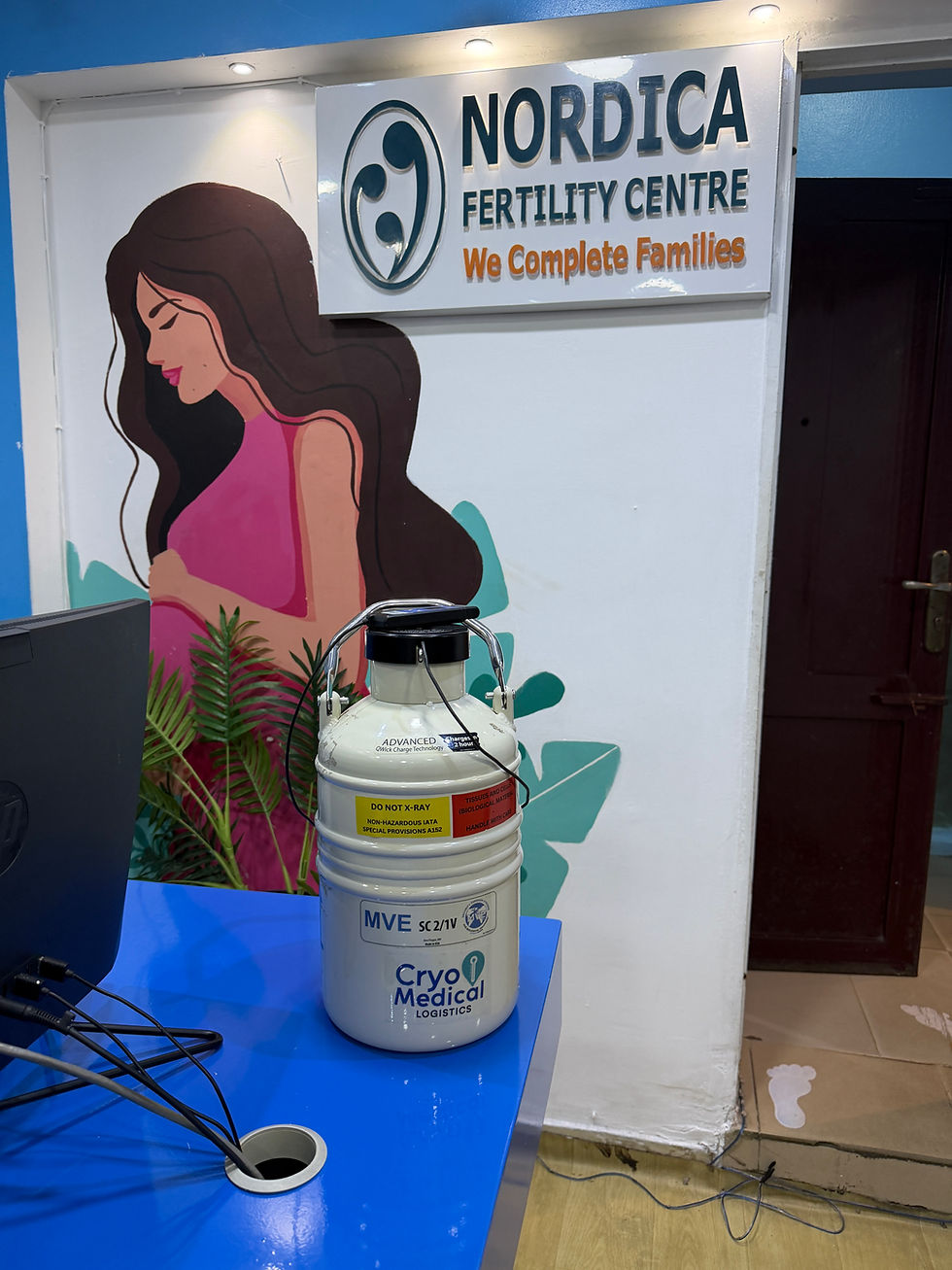
4. Cryogenic packing Your embryos are loaded into a certified, pre-chilled dry shipper by the originating clinic's embryology team, with temperature recorded and the shipper sealed for transit.
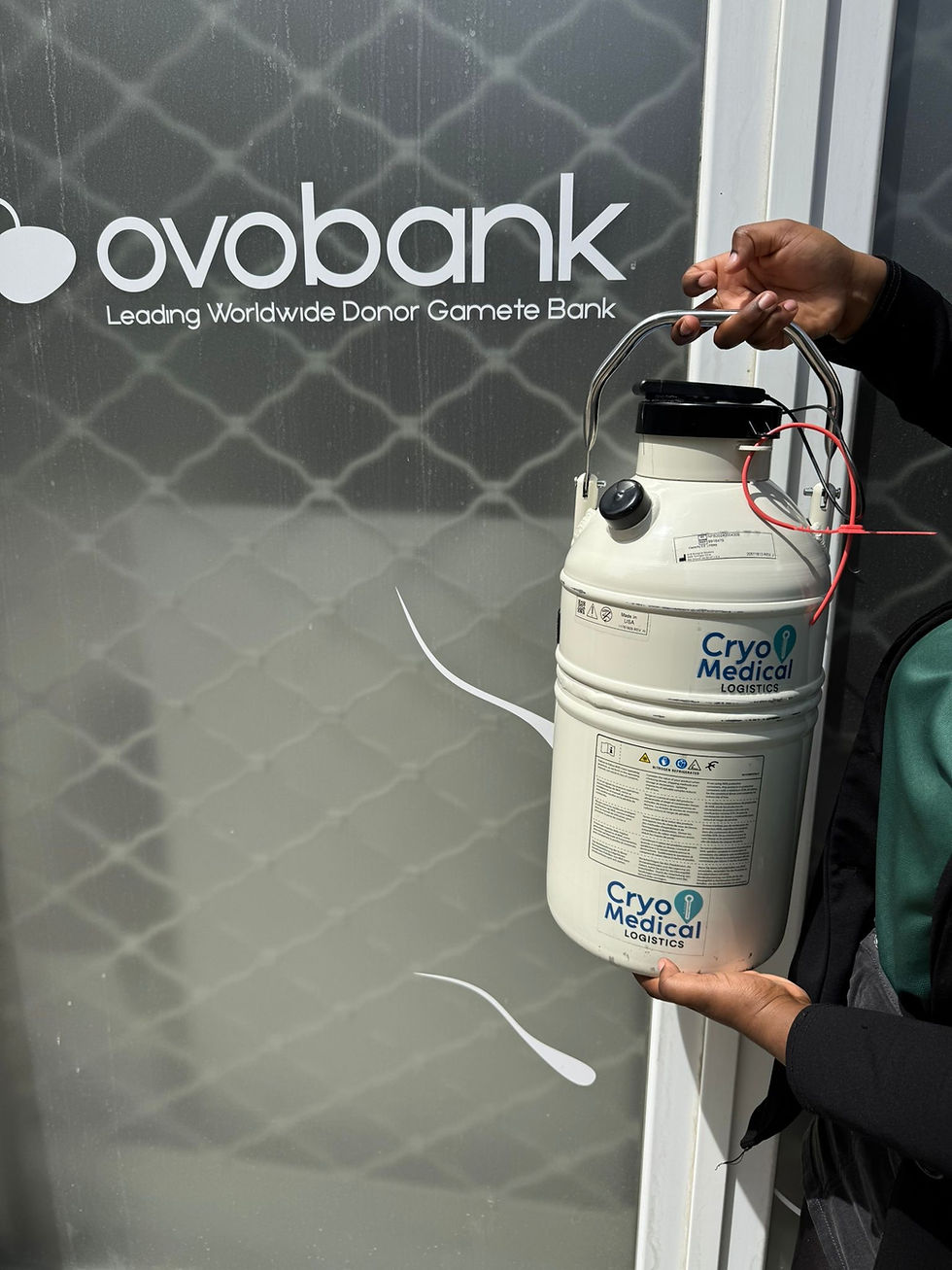
5. Hand-carry transport A trained CML courier personally escorts the dewar as hand luggage on every flight segment — never as cargo. This is the core of what makes CML's service different: continuous personal oversight from clinic to clinic, with the Do Not X-Ray protocol actively enforced at every screening point, and continuous temperature monitoring with data logging throughout.
6. Delivery and confirmation Standard transit runs 24–72 hours depending on route and customs, with photo evidence and real-time updates provided throughout. Samples are handed directly to the receiving clinic's team, not left at a desk or depot.
What documentation do you need?
At minimum, expect to need:
Export consent from the originating clinic/country's regulatory body (e.g. an HFEA Special Direction if shipping from the UK)
A transport agreement between you, the originating clinic, and CML
Invoices specifying exact sample quantity and shipping equipment
Import consent and any documentation required by your receiving Ghanaian clinic
Consent forms — some jurisdictions require written consent from both partners before export
We manage the preparation and pre-clearance of all of this on your behalf, coordinating directly with both clinics so you're not the one chasing paperwork between two countries.
Cost and timeline
Typical cost: shipments from Europe to Ghana generally range from £3000 depending on route complexity, equipment used, and administrative requirements. Always get a personalised quote and confirm exactly what's included — particularly insurance and customs handling, since not every provider includes both.
Typical transit time: 2–6 days door to door, including customs clearance.
Insurance: CML offers coverage on every shipment, with cover available up to £36,750 — ask us to confirm the right level for your specific shipment.
Common questions
Is international embryo shipping to Ghana routine? Yes — with the right provider managing documentation and hand-carry transport, it's a well-established and safe process. The risk sits almost entirely in using an inexperienced or general-purpose courier.
Will my embryos be X-rayed at any point? Not with CML. We use special processes and documentation specifically to avoid X-ray exposure at every checkpoint on the route.
Do I need to travel with my embryos myself? No — our trained courier hand-carries the shipment personally, escorting it through every stage of the journey so you don't have to.
What if my shipment gets delayed at customs? This is exactly what pre-clearance is designed to prevent. Because we prepare and submit documentation ahead of transit and coordinate directly with customs and both clinics, delays of the kind that put unspecialised shipments at risk are largely avoided.
Beyond transport: CML manages the full surrogacy journey in Ghana
Getting embryos safely into the country is only the first piece. For many of the intended parents we work with, the real question is bigger: how do I actually build a surrogacy journey in Ghana, from matching through to bringing my child home? This is where CML goes further than a courier ever could.
Ghana has a genuinely statutory legal framework for surrogacy — the Registration of Births and Deaths Act, 2020 (Act 1027). Under Section 22, intended parents can apply to Ghana's High Court for a Pre-Birth Parental Order, meaning legal parenthood is established before the child is born, and the intended parent's name — not the surrogate's — appears on the birth certificate from day one. This isn't a workaround or a grey-zone practice; it's codified law, which gives Ghana a level of legal clarity that many other African and international destinations simply don't have.
We coordinate the full journey around that legal framework:
Surrogate matching and screening, working with vetted partner agencies and clinics who screen for medical fitness, psychological readiness, and clean background history
Clinic selection and coordination, drawing on our established relationships with fertility clinics and hospitals across Accra and beyond
Embryo and sample logistics, using the same hand-carry, cold-chain standard covered above — so the medical and legal sides of your journey are never disconnected from the physical transport that makes them possible
Legal process coordination, connecting you with the right Ghanaian legal counsel for the Pre-Birth Parental Order application and guiding you on what home-country steps (citizenship, passport, parental recognition) you'll likely need to plan for afterward
On-the-ground support during travel, through our concierge arm, The Restoration Retreat — covering accommodation, in-country coordination, and support around both the Pre-Birth Order hearing and the birth itself
Ghana surrogacy for single men
One of the clearest strengths of Ghana's legal framework is that it does not exclude single men. Heterosexual single intended fathers — whether Ghanaian nationals or international — have a formally defined path to legal parenthood under Section 22 of Act 1027, using the same Pre-Birth Parental Order process available to couples. For men who have found that domestic surrogacy in their home country is unaffordable, legally inaccessible, or simply unavailable to single applicants, this makes Ghana one of the more realistic and legally structured options currently available in Africa.
We support single fathers through the same full journey outlined above — surrogate matching, clinic coordination, embryo or sperm logistics, legal process, and in-country support — with a dedicated coordinator managing communication and documentation throughout, so you're never navigating two countries' worth of paperwork alone.
Worth being upfront about: Ghana's legal recognition under Act 1027 applies specifically to heterosexual intended parents. Ghana is not currently a suitable destination for same-sex intended parents — the country's legal and political environment, including recent legislation, makes this an unsuitable option, and we'll always tell you plainly where that's the case rather than overselling a route that won't work for your circumstances.
Beyond Ghana: full African corridor coverage
Ghana is one of many African fertility corridors we operate in directly, alongside Nigeria, Kenya, Côte d'Ivoire, Uganda, Zambia, Tanzania, Cameroon, Ethiopia, Mozambique, and more. If your journey involves treatment planning, clinic selection, or travel coordination around your shipment — not just the transport itself — our concierge arm, The Restoration Retreat, can support that side too.
Get in touch
Whether you need a single embryo shipment or a fully coordinated surrogacy journey — including for single fathers — talk to CML before you book anything. We'll give you a clear, honest picture of what your route, timeline, and options actually look like.
Contact us:
WhatsApp: +447585610211
Phone: +442081500059
This article is for general informational purposes and does not constitute legal or medical advice. Requirements vary by originating country and by Ghanaian clinic — always confirm specifics with your clinic and with CML before shipping.



Comments