IVF, Fertility, Surrogacy and Embryo/Sperm/Oocyte Shipping in Ecuador: The Complete Guide on Price, Process, and Steps with Cryo Medical Logistics


Contact Cryo Medical Logistics today.
📧 Email: transports@cryomedicallogistics.com
📱 WhatsApp: +44 7585 610211
📞 Phone: +44 2081500059
IVF, Fertility, Surrogacy and Embryo Shipping in Ecuador: The Complete Guide
Ecuador doesn't come up as often as Mexico or Colombia when people start researching fertility treatment in Latin America, but it should.
We work with families and clinics across more than 80 countries moving frozen embryos, sperm and eggs by supervised hand-carry, and Ecuador is a corridor we get more questions about every year — from Ecuadorian couples looking to freeze or transport their own material abroad, to intended parents abroad asking whether Ecuador is worth considering for treatment.
This guide brings together everything we've found in our own market research: how many clinics operate in the country, what treatment actually costs, what the legal picture looks like for IVF and surrogacy, and — because it's our specialty — exactly how embryo, sperm and egg shipping works if your treatment involves Ecuador at either end.
Quick answer
Ecuador offers established, moderately priced IVF and ICSI treatment (roughly a third to half of US pricing), a growing number of accredited clinics concentrated in Quito, Guayaquil and Cuenca, and a fertility rate of infertility affecting an estimated 15–17% of couples of reproductive age. Surrogacy, however, remains legally undefined — there is no law that regulates it one way or the other, which means real uncertainty for anyone considering it as a route to parenthood in Ecuador. IVF, ICSI, egg/sperm banking, and fertility preservation are all well established and regulated as standard medical procedures.
Why people are searching for this right now
Search interest in "IVF Ecuador," "fertility clinic Quito," "FIV Guayaquil precio" and "surrogacy Ecuador" has been climbing alongside a wider trend of patients comparing Latin American countries against each other rather than just against the US or Europe.
The typical questions we see are:
How much does IVF/ICSI actually cost in Ecuador compared to the US, Colombia or Mexico?
Is surrogacy legal in Ecuador?
How many fertility clinics are there, and which cities have them?
Can foreign intended parents freeze eggs/sperm/embryos in Ecuador and ship them home (or vice versa)?
What's the real step-by-step process, start to finish?
We've structured this guide to answer each of those directly.
The fertility landscape in Ecuador
Infertility affects an estimated 15–17% of Ecuadorian couples of reproductive age — roughly one in six — according to national statistics agency INEC data cited in recent Ecuadorian press coverage. Public hospitals do not generally offer IVF in-house (a low-cost pilot programme was proposed at Hospital Eugenio Espejo in Quito), which means the overwhelming majority of assisted reproduction happens in the private sector.
As of recent counts, at least 19 specialized reproductive medicine centers operate across Ecuador's three largest cities — Guayaquil, Quito and Cuenca — with newer clinics continuing to open (a new center opened in Guayaquil in 2025). Some clinics, like Concebir in Quito, hold accreditation from REDLARA (the Latin American Network of Assisted Reproduction), the region's main quality benchmark for fertility care.
Table 1: Major fertility clinics in Ecuador
Clinic | City | Notes |
INNAIFEST | Guayaquil | Over 37 years in operation; associated with the first IVF birth in Ecuador |
Unidad de Fertilidad — Hospital Alcívar (Dr. Valdivieso) | Guayaquil | Long-established; hospital-affiliated |
Concebir | Quito | 30+ years; REDLARA-accredited |
Repromed | Quito | Full-service fertility clinic |
CERH (Centro de Reproducción Humana) | Quito | 30+ years; IVF pioneer |
ENDOGYN | Quito, Guayaquil, Manta, Portoviejo, Ambato, Ibarra | Multi-city network; PCOS specialty |
Quito | Publishes itemized pricing | |
FERTIMEDEX | Quito | 20+ years in reproductive medicine |
Clínica Médica Fertil | Ibarra | Regional (northern Ecuador) |
BioGEPA | Cuenca | Serves southern Ecuador |
Centro Ecuatoriano de Reproducción Humana | Guayaquil | Newly opened (2025) |
Provida Nacer | Quito | Assisted reproduction techniques |
This list reflects clinics with a visible public presence and is not exhaustive or ranked; always verify current accreditation and outcomes directly with a clinic before committing.
What it actually costs
Ecuadorian clinics that publish pricing tend to be more transparent than many international destinations, quoting all-inclusive figures that include medication. Based on published clinic pricing, here's what a treatment budget looks like in 2026:
Table 2: Ecuador fertility treatment pricing (USD)
Treatment | Typical cost (Ecuador) | Notes |
Artificial insemination (IUI), partner sperm | ~$1,300 | Includes medication |
IVF / ICSI (standard cycle) | $5,000 – $7,400 | Includes medication; varies by clinic and city |
Embryo freezing/vitrification | ~$750 | Per published clinic rate |
Embryo thaw and transfer (FET) | ~$1,000 | Per published clinic rate |
Testicular sperm biopsy / epididymal aspiration | ~$675 | For male-factor cases |
Sperm freezing | ~$200 | Per sample |
Egg donation cycle | Not consistently published | Request itemized quote directly |
For comparison, a comparable IVF/ICSI cycle in the US typically runs $15,000–$30,000+ before donor costs, and in Colombia roughly $3,500–$5,500 (converted from EUR). Ecuador sits close to Colombia on price, generally undercutting the US by 60–75%.
A note on "headline" pricing: as with any country, the quoted cycle price may or may not include the initial consultation, baseline testing, anesthesia, PGT (genetic testing), or storage fees beyond the first year. Always ask for a fully itemized quote before treating the headline number as your total cost.
Why people choose Ecuador for treatment — and why some don't
Table 3: Ecuador fertility treatment — advantages and disadvantages
Advantages | Disadvantages |
Treatment cost roughly a third to half of US pricing | No dedicated national law governing assisted reproduction or surrogacy — regulation relies on general health law, not ART-specific statute |
30+ years of clinical experience at several clinics (some of the longest-running programmes in Latin America) | Surrogacy remains legally undefined, creating real uncertainty over parentage, birth registration, and recognition for foreign intended parents |
REDLARA accreditation available at some centers, aligning practice with regional quality benchmarks | Fewer large multi-country clinic networks than Mexico, Colombia or Spain — most clinics are independent, single-country operations |
Multiple cities with clinics (Quito, Guayaquil, Cuenca, and smaller centers), reducing the need to travel to a single hub | No official government statistics tracking IVF outcomes or surrogacy arrangements, making it harder to independently verify success rates |
Growing, actively expanding market (new clinics opening as recently as 2025) | Public healthcare doesn't cover IVF, so all costs are out-of-pocket even for residents |
Spanish-language, Latin American cultural fit for patients from other Spanish-speaking countries in the region | English-language support and international patient coordination is less standardized than in Mexico, Colombia or Spain, which actively market to international patients |
Surrogacy in Ecuador: the honest picture
We're not going to soften this: surrogacy in Ecuador is legally undefined. There is no comprehensive law that permits, regulates, or bans it. Assisted reproductive technologies generally are available and practiced, but surrogacy specifically sits in a gray area, which means:
Parental rights, birth registration, and legal recognition of the arrangement depend on court interpretation rather than clear statute.
There's no legal framework specifically protecting either the surrogate or the intended parents.
Foreign intended parents face additional uncertainty around citizenship procedures and getting their home country to recognize the arrangement.
Regional legal researchers group Ecuador with Argentina, Chile and Peru as "legally uncertain" for surrogacy — a very different category from Colombia (relatively accessible) or Brazil (regulated but restrictive). If surrogacy is part of your plan, independent legal counsel in Ecuador — not just a clinic's word — is essential before starting anything.
The process, step by step
Initial consultation and diagnostics — either remotely or in-person, covering hormone panels, semen analysis, and ultrasound/imaging as needed.
Treatment planning — clinic recommends IUI, IVF, IVF-ICSI, or a donor-assisted pathway based on diagnosis and age.
Ovarian stimulation (if applicable) — typically 10–14 days of monitored injectable medication.
Egg retrieval and fertilization — a day-case procedure under sedation, followed by lab fertilization (conventional IVF or ICSI).
Embryo culture and, if elected, freezing — embryos are grown for 3–5 days; unused embryos can be vitrified for later transfer.
Embryo transfer — fresh or frozen, guided by ultrasound.
Two-week wait and pregnancy test.
If material needs to travel — either because embryos were created in Ecuador and need to move to a clinic abroad, or because a couple wants existing frozen material shipped into an Ecuadorian clinic, this is where specialist cryogenic courier logistics come in (see below).
Shipping embryos, sperm and eggs to or from Ecuador
This is where we can speak from direct operational experience rather than secondary research. Moving reproductive biomaterial across a border is not like shipping general cargo, and it's not something that should go through standard freight or postal channels.
What's actually involved:
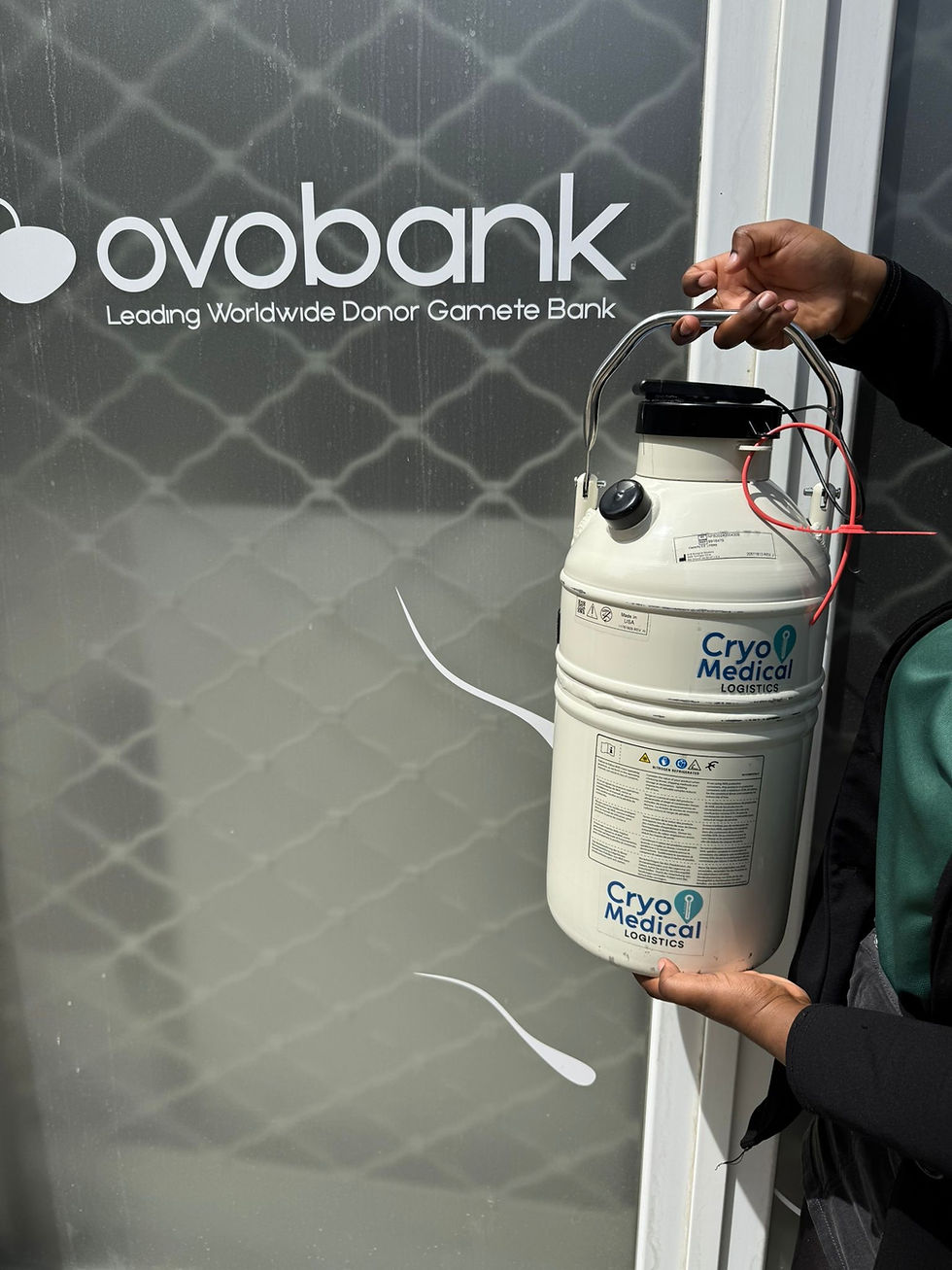
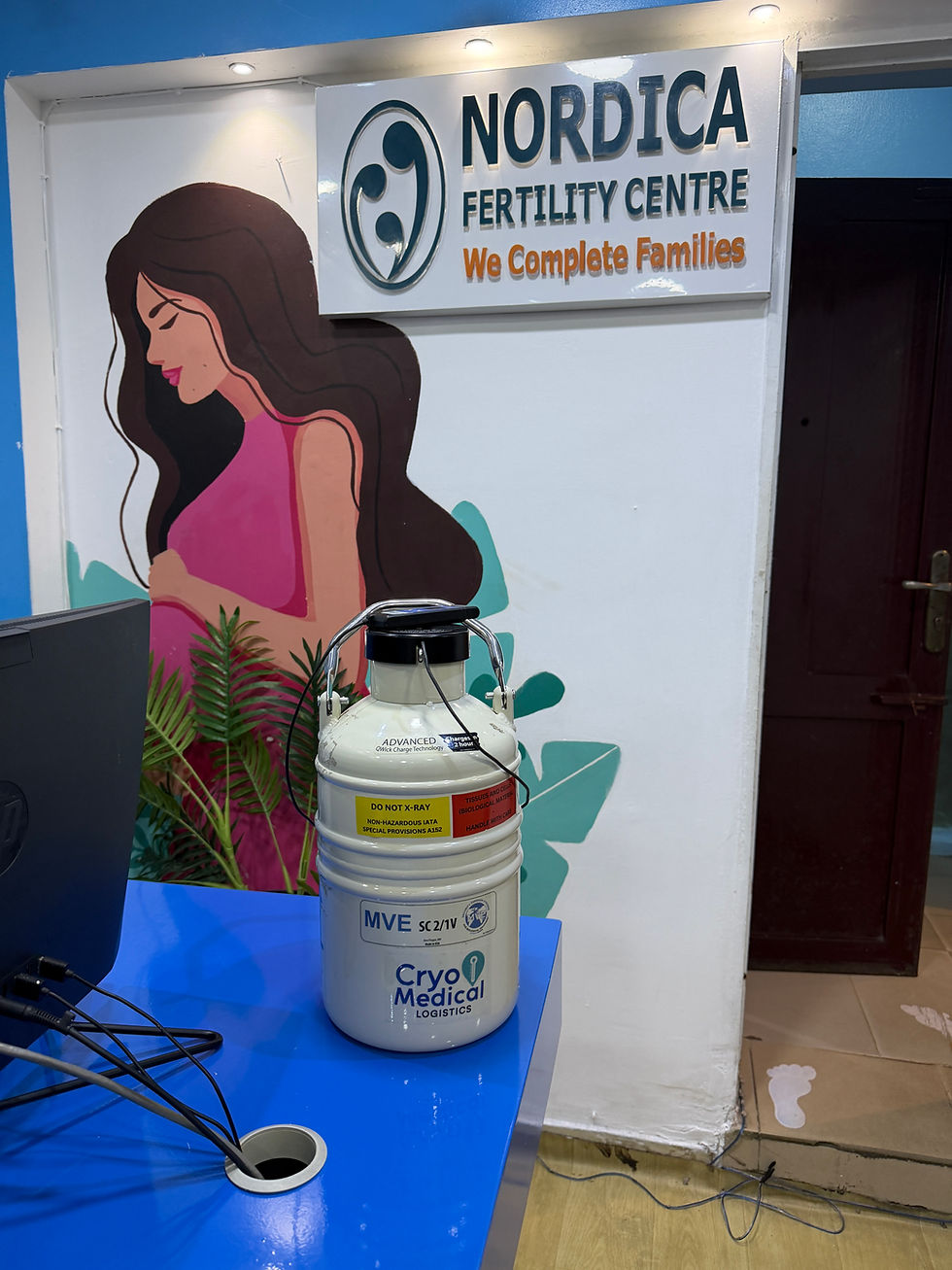
Supervised hand-carry, not cargo. Reproductive material is carried by a trained courier as accompanied baggage, monitored door to door, rather than checked into a cargo hold. This avoids X-ray exposure risk and keeps the material under continuous human supervision.
Dry shipper (vapor-phase nitrogen) transport. Samples travel in a validated cryogenic dry shipper that maintains ultra-low temperature without liquid nitrogen sloshing, and that's certified for commercial air travel.
Do Not X-Ray protocol. Reproductive cells are sensitive to ionizing radiation, so shipments are hand-inspected at security checkpoints under an explicit no-X-ray declaration, coordinated in advance with airport and airline security teams.
Full chain-of-custody documentation. Every handoff — clinic to courier, courier to airline, airline to receiving clinic — is logged, signed and time-stamped, so both the sending and receiving clinics have a complete record.
Customs and import documentation. Shipments require a customs declaration identifying the contents as human biological material for medical use, consent documentation from the patient(s), and — depending on the receiving country — an import authorization from the receiving clinic. Ecuador's general customs process runs through SENAE and the ECUAPASS platform, and international shipments of biological material typically move faster with a customs agent experienced in this specific category, since it doesn't fit standard commercial goods categories.
Temperature continuity. Reputable couriers monitor and log temperature throughout transit and can top up nitrogen at transit hubs if a journey runs long, so the receiving embryologist has full visibility into whether the sample stayed within safe range the entire trip.
Why this matters for Ecuador specifically: because Ecuador doesn't have IVF-specific import/export legislation the way some countries do, documentation quality and a courier who has actually worked this corridor before matter more, not less. Getting the customs declaration, chain-of-custody paperwork, and receiving clinic's import requirements aligned in advance is what prevents a shipment sitting in a bonded warehouse instead of a dewar.
Frequently asked questions
Is IVF legal in Ecuador? Yes. IVF, ICSI, egg and sperm freezing, and donor gamete treatment are established, practiced procedures at private clinics across the country.
Is surrogacy legal in Ecuador? There's no law that says yes or no — it's unregulated, which in practice means significant legal uncertainty rather than a green light.
How much does IVF cost in Ecuador? Published clinic pricing puts a standard IVF/ICSI cycle including medication at roughly $5,000–$7,400.
How many fertility clinics are in Ecuador? At least 19 specialized centers are known to operate, concentrated in Quito, Guayaquil and Cuenca.
Can I ship frozen embryos into or out of Ecuador? Yes, this is a routine (if specialized) service. It requires a supervised hand-carry courier, proper customs declaration as human biological material, and coordination between the sending and receiving clinics — not standard freight or mail.
Is Ecuador cheaper than the US for IVF? Yes, typically by 60–75%, and broadly comparable to Colombia.
Every transport. Every time. If your treatment plan involves moving embryos, sperm or eggs into or out of Ecuador, our team handles the supervised hand-carry, customs coordination, and chain-of-custody documentation end to end. Get in touch to talk through your specific route and timeline.
Get a Quote for Your Specific Corridor
Cryo Medical Logistics operates across 80 countries with active hand-carry corridors from the UK, USA, Canada, Europe, Nigeria, South Africa, Kenya, the UAE, India, Australia, and beyond. Every quote is specific to your route, your clinics, and your regulatory situation.
📧 Email: transports@cryomedicallogistics.com
📱 WhatsApp: +44 7585 610211
📞 Phone: +44 2081500059



Comments