Surrogacy in Africa: Top 3 Countries - Nigeria, Ghana & Kenya - By Cryo Medical Logistics

By Cryo Medical Logistics | The Worldwide Leader in IVF Transport Across Africa | African Head Office: Lagos, Nigeria

You've tried. You've hoped. You've waited. And now you're exploring every option — because becoming a parent is not something you're willing to give up on.
Surrogacy in Africa is one of the fastest-growing options for intended parents around the world — offering a genuine path to parenthood at a fraction of the cost of the US or UK, with skilled clinics, caring surrogates, and increasingly structured legal processes.
Contact Cryo Medical Logistics
WhatsApp: +44 7585610211
Phone: +44 2081500059
Website: www.cryomedicallogistics.com
This guide breaks down the three leading surrogacy destinations on the continent — Nigeria, Ghana, and Kenya — covering everything you need to know: costs, legal frameworks, how the process works, what to watch out for, and the one thing most people don't think about until it's almost too late: how your embryos, sperm, or IVF medication actually gets there.
At Cryo Medical Logistics , we've built our African operations from our Lagos headquarters to serve intended parents, fertility clinics, and agencies across Nigeria, Ghana, Kenya, and beyond. We know these markets — not from a distance, but from the ground.
Why Are Intended Parents Choosing Africa for Surrogacy?
The global surrogacy landscape has shifted dramatically over the last decade. India closed to international surrogacy in 2021. Thailand, Nepal, and Cambodia shut their doors years earlier. The US remains a viable but eye-wateringly expensive option — often exceeding $100,000 from start to finish.
Africa has stepped into that gap.
Countries like Nigeria, Ghana, and Kenya are seeing rapidly expanding fertility infrastructure, growing pools of experienced surrogates, and costs that make surrogacy accessible to people who would otherwise never be able to afford it. International intended parents are increasingly looking to sub-Saharan Africa as a credible, compassionate, and cost-effective destination.
Key reasons people are choosing Africa:
Total costs from $20,000–$55,000 compared to $80,000–$170,000+ in the US
Growing number of internationally trained fertility specialists
Expanding clinic infrastructure in Lagos, Accra, and Nairobi
Large surrogate populations motivated by both altruism and financial security
Improving (if still evolving) legal frameworks in all three countries
Proximity for diaspora families already connected to these countries
#1: Nigeria — Africa's Largest Fertility Market
Overview
Nigeria is the most populous country in Africa, home to the continent's largest economy and a booming private healthcare sector. Lagos, in particular, has seen an explosion of fertility clinics catering to both domestic clients and the substantial Nigerian diaspora returning from the UK, USA, Europe, and beyond.
Surrogacy in Nigeria is not prohibited — but it is unregulated. There is currently no dedicated national legislation governing surrogacy. What does exist is a framework of common law, professional medical ethics guidelines, and contract law that experienced agencies and clinics navigate on a daily basis.
Legal Framework
Nigeria currently operates in what legal experts describe as a "grey area." Surrogacy is neither explicitly legal nor explicitly illegal — which means it is practiced openly, particularly in private fertility clinics.
The Nigeria Surrogacy Regulatory Commission Bill 2024 has been tabled in Parliament and, if passed, would represent a landmark shift — providing formal rights and obligations for all parties, permitting financial compensation, and potentially opening the door to cross-border surrogacy with structured oversight.
In the meantime, surrogacy contracts are drafted and executed under general contract law principles. These are not always enforceable in the same way as in jurisdictions with dedicated legislation — which is precisely why working with reputable, experienced agencies and specialist legal counsel is essential.
In the absence of Nigerian-specific legislation, many clinics in Nigeria apply standards informed by the UK Human Fertilisation and Embryology Act — a practical measure given Nigeria's common law heritage.
What this means for you:
Written, legally reviewed surrogacy agreements are non-negotiable
Parental rights must be established post-birth through legal proceedings
UK intended parents will need a Parental Order to establish legal parenthood at home
US intended parents should work with state-specific legal advisors
LGBTQ+ intended parents face the most significant legal complexity given Nigeria's social and legislative environment
Cost of Surrogacy in Nigeria
Nigeria is one of the most affordable surrogacy destinations in the world. Total costs typically range from $20,000 to $40,000 USD, making it significantly cheaper than most alternatives globally.
Cost Component | Estimated Range |
Surrogate compensation | $3,000–$8,000 |
IVF / medical procedures | $3,000–$10,000 |
Agency fees | $5,000–$10,000 |
Legal fees | $1,000–$5,000 |
Antenatal & prenatal care | $1,500–$4,000 |
Miscellaneous / contingency | $1,000–$3,000 |
Total estimated range | $20,000–$40,000 |
Note: Costs vary significantly based on clinic, city (Lagos vs other cities), agency, number of IVF cycles required, and specific legal complexity.
How Is Surrogacy Managed in Nigeria?
Nigeria's surrogacy ecosystem is largely agency and clinic-led. Most intended parents work through a surrogacy agency — which handles surrogate matching, psychological screening, medical coordination, and legal support — in partnership with an IVF clinic that manages the medical procedures.
IVF success rates in Nigeria for women under 35 are reported at 60–80% per cycle, which is competitive by international standards.
Timeline
The full Nigerian surrogacy journey — from initial consultation to birth — typically takes 12 to 15 months, influenced by how quickly a suitable surrogate is matched and how many IVF cycles are needed.
#2: Ghana — The Most Legally Structured Option in West Africa
Overview
Ghana is increasingly recognised as West Africa's most structured surrogacy destination. The country has a functioning commercial surrogacy industry, a growing pool of fertility clinics concentrated in Accra, and — importantly — a legal environment where courts have demonstrated willingness to grant pre-birth parental orders recognising intended parents' rights from the moment of birth.
This last point matters enormously. For international intended parents, having legal parenthood confirmed before you leave the hospital is a powerful protection.
Legal Framework
Like Nigeria, Ghana does not have dedicated surrogacy legislation. However, the absence of a specific statute does not mean the process is legally unprotected. Ghana's legal system supports:
Pre-birth parental orders through the courts — meaning your legal status as parent can be established before the child is born
Structured contractual agreements between intended parents and surrogates
Court-supported parentage processes that are well-established in practice
Ghana is widely regarded as offering the strongest legal safeguards in West Africa for surrogacy, and its courts have developed a working precedent for handling these cases.
What this means for you:
Surrogacy is legal and practiced openly
Pre-birth orders make the legal transition smoother than in countries relying solely on post-birth proceedings
No restrictions on the nationality of intended parents — international couples are welcome
The process is typically clinic and agency-managed, with legal support built into packages
Cost of Surrogacy in Ghana
Ghana sits at a mid-range price point on the African scale. Total costs typically run from $20,000 to $58,000 USD, with guaranteed surrogacy programs (which include multiple embryo transfers and surrogate rematching if needed) at the higher end.
Cost Component | Estimated Range |
Surrogate compensation | $8,000–$15,000 |
IVF / medical procedures | $6,000–$12,000 |
Agency fees | $5,000–$10,000 |
Legal fees (inc. pre-birth order) | $3,000–$7,000 |
Psychological support | $1,000–$2,500 |
Accommodation & care for surrogate | $2,000–$5,000 |
Total estimated range | $30,000–$58,000 |
Guaranteed surrogacy programs — covering up to four embryo transfers and surrogate rematching — average $40,000–$60,000.
How Is Surrogacy Managed in Ghana?
Ghana's surrogacy market is primarily agency-led with clinic partnerships. Surrogates undergo comprehensive medical and psychological screening, and reputable programs include ongoing care, accommodation, and nutritional support for surrogates throughout pregnancy.
The surrogate matching process typically takes 2–4 weeks once a program is initiated, making Ghana one of the faster-matching destinations on the continent.
Accra is the centre of gravity for fertility services, though the ecosystem is growing. Exit procedures — including birth certificates and passports — typically take 4–6 weeks post-birth for international families.
Typical process:
Initial consultation and medical assessment
Surrogate matching
Legal agreement and pre-birth order process
IVF and embryo transfer
Pregnancy monitoring and surrogate care
Birth and legal handover
Documentation for international travel
#3: Kenya — East Africa's Growing Surrogacy Hub
Overview
Kenya has become East Africa's primary fertility and surrogacy destination, with Nairobi housing a growing cluster of internationally oriented fertility clinics. The country's constitution guarantees the right to form a family as a fundamental social unit — a cultural and legal foundation that creates a broadly permissive environment for assisted reproduction.
Like Nigeria and Ghana, Kenya currently lacks dedicated surrogacy legislation. An Assisted Reproductive Technology Bill has been in development for years, proposing formal regulation of surrogacy including altruistic arrangements for heterosexual couples — but as of 2025, it remains unratified.
Legal Framework
Surrogacy in Kenya operates through private contracts in the absence of a specific legal statute. The key legal steps for international parents include:
A binding surrogacy agreement drafted by an experienced surrogacy lawyer
Post-birth, intended parents must file a petition with the court (typically on day 3 post-birth) to be recognised as legal parents
The court then directs the Vital Statistics Department to issue a new birth certificate naming the intended parents
Under current Kenyan law, the surrogate is considered the legal mother at birth — making the post-birth court process an essential, non-optional step.
Kenya is a broadly safe surrogacy environment for heterosexual couples. LGBTQ+ intended parents face significant challenges, as same-sex relationships remain illegal and socially stigmatised in Kenya.
What this means for you:
Private contracts are the foundation of the entire arrangement
Court process post-birth is necessary and should be planned for
International families may need to factor in additional stay time post-birth
Choose agencies and clinics with established legal partnerships and experience navigating the court process
Cost of Surrogacy in Kenya
Kenya offers competitive pricing, typically ranging from $33,000 to $52,000 USD, with gestational surrogacy at the higher end.
Cost Component | Estimated Range |
Surrogate compensation | $7,000–$12,000 |
IVF / medical procedures | $7,000–$12,000 |
Agency fees | $5,000–$8,000 |
Legal fees | $3,000–$6,000 |
Surrogate care (food, accommodation, travel) | $3,000–$6,000 |
Post-birth legal proceedings | $2,000–$4,000 |
Total estimated range | $33,000–$52,000 |
How Is Surrogacy Managed in Kenya?
Kenya's surrogacy ecosystem is clinic and agency-driven, centred predominantly in Nairobi. Fertility services are expanding into other cities, but Nairobi remains the hub for internationally oriented programs.
Surrogate mothers in Kenya are screened for health conditions including hepatitis, hypertension, and cardiac issues before being approved. Kenyan surrogates must typically be at least 25 years of age.
Kenya's growing fertility sector is attracting international investment and expertise, and success rates continue to improve. The country is increasingly seen as a credible destination for diaspora Africans and international intended parents seeking an East African option.
Country Comparison Table
Feature | Nigeria | Ghana | Kenya |
Legal status | Grey area — no specific law | No specific law, court-supported | No specific law, contract-based |
Pre-birth parental orders | Not standard | Yes — available | Not standard |
Post-birth legal process | Required | Streamlined | Court petition required |
Total cost range | $20,000–$40,000 | $30,000–$58,000 | $33,000–$52,000 |
Surrogate compensation | $3,000–$8,000 | $8,000–$15,000 | $7,000–$12,000 |
Open to international parents | Yes | Yes | Yes (heterosexual) |
LGBTQ+ accessible | Very limited | Limited | Very limited |
Process managed by | Clinics & agencies | Agencies & clinics | Clinics & agencies |
Primary fertility hub | Lagos | Accra | Nairobi |
Typical timeline | 12–15 months | 12–18 months | 15–24 months |
IVF success rate | 60–80% (under 35) | Improving | Improving |
Surrogate pool | Large | Growing | Growing |
Legal framework strength | Developing | Strongest in West Africa | Developing |
ART Bill/Regulation pending | Yes (2024 Bill) | Ongoing | Yes (ART Bill) |
The Part Most Intended Parents Don't Think About Until It's Almost Too Late
But there's a critical logistics question that doesn't get answered until late in the process — and answering it wrong can delay or derail your entire journey.
How does your biological material actually get there?
Whether you're sending frozen embryos from a clinic in the US, the UK, or Europe — or you need your husband's sperm to travel to Lagos or Accra — the answer involves highly specialised cryogenic logistics. Not courier services. Not general freight. Specialist, temperature-controlled, chain-of-custody controlled cryogenic shipping.
This is what Cryo Medical Logistics does. And we do it better than anyone else in Africa.
We Ship Embryos to Africa
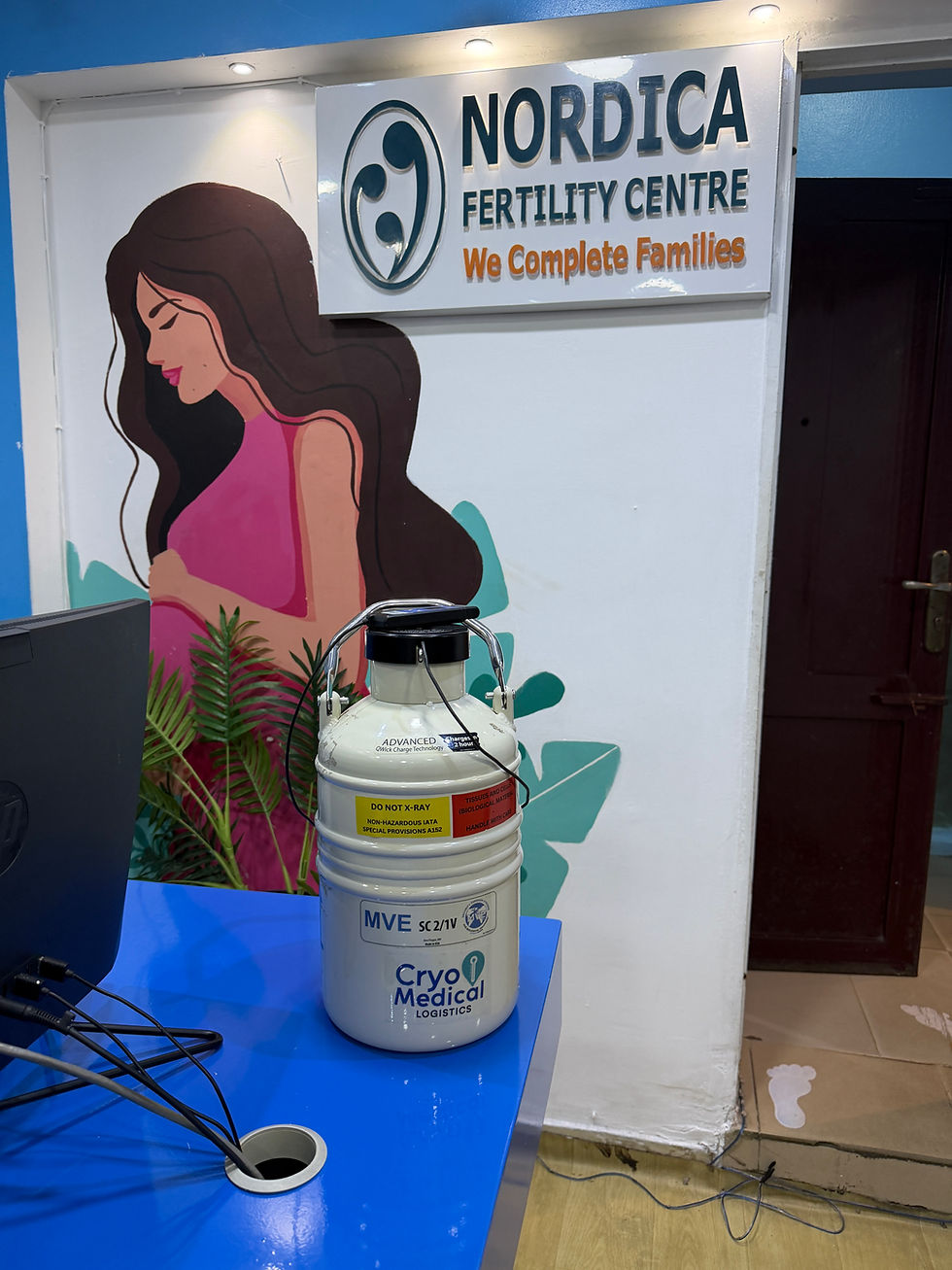
If your embryos are stored at a clinic in the US, UK, or anywhere in Europe, we arrange their safe collection, temperature-controlled transport, and delivery to your chosen clinic in Nigeria, Ghana, or Kenya. Every shipment is ISO 9001:2015 certified, with full chain of custody documentation and uninterrupted temperature monitoring throughout.

We Ship Sperm
Your husband doesn't need to be in Africa for egg retrieval. We can arrange the safe, compliant transport of frozen sperm samples from your home country clinic to your African clinic — meaning you minimise the time you need to spend abroad and avoid the logistical and professional complexity of both partners having to travel for extended periods.


We Ship Your IVF Medication
This one surprises people. If you're beginning an IVF stimulation protocol before you travel — which many intended parents do specifically to reduce the amount of time they need to spend at their destination clinic — your medications may need to be shipped to you wherever you currently live.
Whether you're in the US, Canada, Australia, or the UK, Cryo Medical Logistics can arrange the compliant, temperature-sensitive shipping of your fertility medications so you can begin your cycle at home, travel for egg retrieval, and avoid spending three weeks away from your life.
Think about what that means practically. You start your injections at home. You monitor your cycle with your local doctor or via telemedicine. You fly to Lagos, Accra, or Nairobi when your follicles are ready. You have your egg retrieval. And you fly home.
That's a one-week trip, not a three-week absence from work and family.
Cryo Medical Logistics makes that possible.
With our African head office in Lagos and a worldwide logistics network, we are the trusted partner of fertility clinics and intended parents across the continent. We've moved biological material across borders that others said couldn't be done. We understand the regulatory environment in Nigeria, Ghana, and Kenya better than any other logistics provider in the market.
When your future family is in transit — it matters who's carrying it.
Contact Cryo Medical Logistics
WhatsApp: +44 7585610211
Phone: +44 2081500059
Website: www.cryomedicallogistics.com
Frequently Asked Questions About Surrogacy in Africa
Is surrogacy legal in Africa?
Surrogacy is practiced openly in Nigeria, Ghana, and Kenya. None of the three countries has dedicated surrogacy legislation, but none explicitly prohibits it either. Arrangements are governed by private contracts, professional medical ethics, and — in Ghana's case — increasingly by established court procedures including pre-birth parental orders. The legal landscape is evolving in all three countries.
Which African country is best for surrogacy?
There is no single "best" — it depends on your priorities. Nigeria offers the lowest costs and the largest fertility market, making it well-suited for budget-conscious intended parents and diaspora families with Nigerian connections. Ghana offers the most legally structured process in West Africa, including pre-birth orders, and is generally considered the safest legal environment. Kenya is the leading option for East Africa, with good fertility infrastructure in Nairobi and competitive pricing.
Can international parents pursue surrogacy in Africa?
Yes. All three countries — Nigeria, Ghana, and Kenya — are open to international intended parents. There are no restrictions on nationality. However, intended parents should be aware that their home country's laws also apply: UK parents will need a Parental Order, and US parents will need to follow state-specific legal processes to establish parenthood at home.
What is gestational surrogacy and is it available in Africa?
Gestational surrogacy is the standard practice across all three countries. In gestational surrogacy, the embryo is created using the intended parents' (or donors') eggs and sperm through IVF, and transferred to the surrogate's uterus. The surrogate has no genetic connection to the child. This is the preferred method because it provides greater clarity on parental rights and is less legally and emotionally complex than traditional surrogacy.
Can my husband's sperm be shipped to Africa instead of him travelling?
Yes. Cryo Medical Logistics arranges the compliant, temperature-controlled transport of frozen sperm samples from clinics worldwide to fertility clinics in Nigeria, Ghana, and Kenya. This means one partner can travel for procedures while the other's contribution travels separately — simplifying the logistics and reducing the time both partners need to be away.
Can I receive IVF medication in the US or UK before travelling to Africa?
Yes — and this is one of the most practical ways to reduce your time in-country. By beginning your stimulation protocol at home under your local doctor's supervision, you only need to travel to Africa when your eggs are ready for retrieval. Cryomedical Logistics ships fertility medications internationally, ensuring temperature-sensitive medications arrive safely wherever you are in the world.
How long does surrogacy in Africa take from start to finish?
Timelines vary by country and by individual journey. In Nigeria, expect 18–24 months. In Ghana, 12–18 months is more typical. In Kenya, 15–24 months is the general range. Variables include how quickly a surrogate is matched, the number of IVF cycles required, legal processing time, and any complications during pregnancy.
What legal steps do UK parents need to take after surrogacy in Africa?
UK intended parents must apply for a Parental Order upon returning to the UK. This is the legal process that transfers parenthood from the surrogate to the intended parents under UK law. This process requires DNA evidence and typically involves the family court. Cryomedical Logistics works with specialist legal partners to support the DNA testing required for this process.
What should I look for in a surrogacy agency in Africa?
Look for: clear, transparent pricing with no hidden fees; established legal partnerships and a track record of successful parental rights processes; comprehensive surrogate screening (medical and psychological); ongoing care and support for surrogates throughout pregnancy; international client experience; and willingness to work with your home-country legal advisors. Avoid agencies that cannot provide references, that are not transparent about surrogate compensation, or that cannot clearly explain the post-birth legal process.
Is it safe to pursue surrogacy in Africa?
Safety depends heavily on the clinic and agency you work with. Leading clinics in Lagos, Accra, and Nairobi operate to international standards. As with any medical tourism decision, thorough due diligence is essential. Partnering with experienced, reputable agencies and ensuring your biological materials are transported by a certified logistics provider significantly reduces risk.
What happens to my embryos if the first transfer fails?
Most reputable surrogacy programs in Ghana and Kenya include provisions for multiple embryo transfers — and guaranteed programs offer surrogate rematching if the initial surrogate does not achieve pregnancy. It's important to clarify upfront what is included in your package and at what additional cost further attempts would be made.
Can same-sex couples pursue surrogacy in Africa?
This is one of the most complex areas of African surrogacy. Nigeria, Ghana, and Kenya all have legal or social limitations that create significant barriers for LGBTQ+ intended parents. We recommend consulting specialist international surrogacy legal counsel before pursuing surrogacy in any of these countries as a same-sex couple.


Comments